There is a prevailing belief that accumulating more power, wealth, and resources leads to universal value and recognition. Devdutt Pattanaik’s “Escape the Bakasura Trap” challenges this belief and unchecked consumption, which goes along with it. The book draws a compelling parallel between present-day consumption and Bakasura, a character from the ancient Indian epic, the Mahabharata. Bakasura was infamous for his insatiable hunger, consuming not just food resources but even those who served him. Similar patterns of greed and excess can be found in today’s society, and as readers delve deeper, they may recognize a little bit of Bakasura within themselves. While consumption is often seen as a path to power and leisure, little attention is paid to its broader impact on oneself.
Pattanaik assumes that his readers have a general awareness of the epics and literature. This may no longer hold true, as business education is focussed on success, consequently the knowledge imparted is domain-specific. In an indirect manner the book suggests an improved understanding of human nature and our insignificant place in the scheme of things. The path to contentment and happiness may commence with this realization, something that often comes later in life. The book references rare concepts such as the Greek notion of Asphodel. While enriching the content, some readers may have to call for AI assistance to really enjoy the contents.
Pattanaik beautifully distills the essence of the Mahabharata, making it palatable to all, even the mildly spiritual or the truly agnostic readership. The book offers a reflection on the dangers of unrestrained consumption and the dissatisfaction it breeds, serving as a mirror for the reader. Its concise and tightly written style, under 200 pages, requires close attention; every word is significant, and skipping even a sentence can disrupt the narrative’s flow. For business professionals, the advice is clear:- sip it down slowly, savor the ideas, allow the words to sink in and the lessons to resonate fully.
A key message in the book is that consuming and hoarding do not eliminate hunger; instead, they fuel an addiction to consumption. Not everyone benefits equally from this system, and those excluded continually seek their share, leading to ongoing conflict. The dynamics between consumers and the consumed forms the core of the “Bakasura trap.”
The Mahabharata is often seen as a tale of war, but Pattanaik explains that it is indeed a discourse on mediation and contentment. The book discusses the human capacity to imagine—using myths to create meaning, identity, and structure within societies. Myths even influence beliefs about hunger persisting beyond death, as seen in Hindu rituals that involve feeding the dead in anticipation of rebirth. Many belief systems, the author notes, use fear of the afterlife, as a way to influence present behaviour.
An anecdote involving Lord Bramha is used to illustrate the importance of selflessness: Bramha instructs his children to eat without bending their elbows. Those who feed others can do so without bending their elbows and become human. Those who only feed themselves, by bending their torsos but not the elbows, become plants and animals, eternally seeking food.
The book also explores the concept of “Yagna,” where the concept of giving is central. In this ritual, what is given away is offered to a deity (Devta), and while the donor (Yajman) receives no guarantee of return. Giving is motivated by the desire to repay debts and build credit. Pattanaik highlights how this belief distinguishes Indian thought from all others. The idea that those with credit are born into privilege while those in debt suffer, emanates from this belief system. True freedom, the author asserts, means liberation from both debts and credits—pain and pleasure alike. Bakasura, the book’s central figure, is ultimately shunned for only taking and never giving.
“Escaping the Bakasura Trap” is recommended for readers everywhere, as the themes of greed, consumption, and the desire for liberation from them are universal. The lessons learnt herein are relevant for all and go far beyond the corporate world. In a way the book encourages readers to seek and understand the Bakasura archetypes in their own lives, avoiding that path and perhaps escaping the Bakasura trap. Part of the title says it all - Let Contentment Fuel Your Growth.
Friday, 3 October 2025
Thursday, 16 January 2025
On the Epic of Gilgamesh - Ajay Singha, Raconteur Indica
Apparently there are thirty-six dramatic situations, one or more of which is played out in each epic or story ever written. It is therefore no coincidence that tales from ancient civilizations across continents bear similarities and display remarkable commonalities. Originating in different parts of the world, at various points in time, these epics and ancient stories prompt philosophers and religious teachers to question: Did one narrative or belief system based thereon influence another? Does one epic owe its existence to the other? Since the discovery of the ‘new world’ this uncomfortable reality weighed across the minds of the western intelligentsia. Cross-border readers and global thinkers experienced first-hand, the repetitive, interlinked narratives across civilizations. In continents separated by oceans and land mass the commonalities in ancient storylines appears uncanny, emanating as they do from vastly different socio-cultural backdrops. In present times, the likelihood of one story influencing another is understandable, but it harbors the question: How does the infinite imagination of the human intellect, expressed through prose, poetry, art and music remain within the confines of these finite, time-tested, weather beaten dramatic situations?
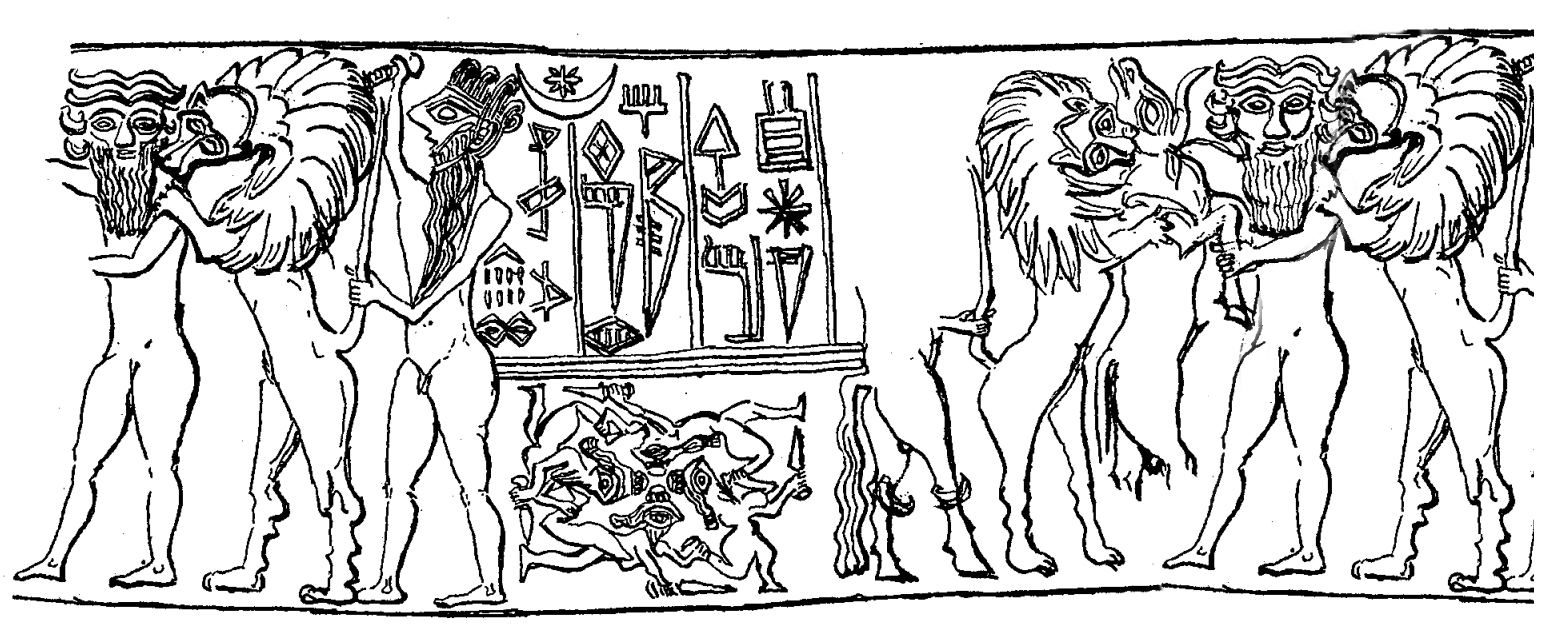
One such story is the epic of Gilgamesh, one of the oldest surviving recorded Babylonian poems. Gilgamesh was a king of Uruk (in modern Iraq) and is believed to have ruled around 2900BC. Historical evidence confirms that the epic was written on clay tablets more than four thousand years ago. Those who care to read the Epic of Gilgamesh will undoubtedly experience a sense of déjà vu. A feeling that one may have read this story or a part it someplace else, and one can predict how the plot may unfold. It would be simplistic to imagine that classic or modern writings have their origins in some form of plagiarism. Especially given the fact that the original Epic of Gilgamesh was translated from ancient cuneiform texts as late as the early 20th century. 2600BC - Gilgamesh and the mythical bull.
Greek, Roman and other early prose, poetry and theatre seems to have their umbilical cord attached to the Epic of Gilgamesh. It is from these works that later classics and modern thinking and writing of the west seem to be influenced. Scholars agree on the deep influence the epic has had on Homer's Illiad and Odessey, written in the 8th century BC. From then on the epic seems to have irrevocably entered western consciousness, deeply influencing western literature and art forever. 2600BC Gilgamesh wrestling with animals (Iraq National Museum)
The book of genesis in the old testament mentions the great deluge and so does the Epic of Gilgamesh. Both accounts attribute the phenomena to the handiwork of God. The deep affection and friendship between Gilgamesh and Enkidu, men of equal strength and vigor stands way back in time, yet the theme gets repeated in several stories, like Achilles and Petrocolus in the Illiad. Gilgamesh is torn apart by immense grief over the loss of his friend, leading to the realization that life is limited and each one of us is in fact racing towards his or her demise. The fear of imminent death grips Gilgamesh and he sets out seeking answers to the “meaning of life” and how to achieve “everlasting life.” These ideas seem to repeat themselves in belief systems, religious literature and stories across centuries. 7th Century BC Assyrian tablet of the Epic mentioning The flood
The epic alludes to creating human beings from clay and dust, a concept which resonates in the Greek and Roman beliefs and echoes in all Abrahamic religious writings. More fundamentally the Epic of Gilgamesh projects civilization and nature in opposition to each other. To be in harmony with nature is preferred, but it gets disturbed as the world progresses. The savage nature of man is portrayed by the character of Enkidu, a theory later propounded and attributed to the philosopher Thomas Hobbes in the 17th century. Enkidu is enticed by a prostitute and after long sexual encounters she ‘civilizes’ him. Later Enkidu and Gilgamesh become inseparable friends and they decide to take on the establishment, namely Humbaba, a kind of penultimate level in the universal hierarchy. A modern day statue of Gilgamesh (University of Sydney)
Ishtar, the goddess of Uruk, proposes marriage to Gilgamesh who flatly refuses, citing her promiscuous past and the pathetic plight of all her previous lovers. She threatens the supreme god, that if he does not approve and ensure this matrimony she would scream so loud as to awaken the dead. Stories of the living dead and zombies can be traced to many regions and continents over centuries. Most importantly it is a woman who shows Enkidu the way, guiding him from a naïve and simplistic existence to a more evolved and meaningful life. The female form is portrayed both as a source of sensual pleasures and a fountain of knowledge. In his search for “everlasting life” Gilgamesh is guided by the goddess Ishtar who advises him to look at the more positive side of life: savor human relationships, especially with family, and take pleasure in enjoying a healthy existence. At the end of the epic Gilgamesh seems to have completed a cycle, yet in metaphorical terms finds himself just where he started. The ‘Carpe diem” theme finally dawns on Gilgamesh, a concept immortalized much later by the roman poet Horace shortly before the birth of Christ. He concludes that one must make the best of life whilst one is alive. The philosopher Voltaire too reaches a similar conclusion in “Candide” via an equally compelling plot and series of interesting incidents. Belief systems, Greek and Roman classics and present day writers in their own ways have extolled the virtues of this kind of a life philosophy. Eckhart Tolle lucidly elucidates this approach in his best-selling seminal work “The Power of Now.” The Goddess Ishtar
It is interesting to note that writers turned portions of the epic into their own property, and rightly so, as there is absolutely no way they could have directly accessed and copied the contents of this epic, yet over centuries it managed to permeate civilizations in the far corners of the globe. There is no living sect or believers who consider the text of this epic as holy or divinely ordained. There is no claim giving the acts and omissions of the key characters of the epic any divine sanction. Storylines, plots, concepts, ideas and thinking are non-linear and zigzag their way across time and geographical boundaries. As civilizations reach their zenith, belief systems and philosophies emerge, only to fade away in the mist of time. The plots and storylines which hold them together continue the metamorphoses while retaining their original ethos. They remain inextricably interwoven with human nature which defies time and remains unchanged. The epic continues to shine as a master source of knowledge across time and space for all to access and write their own stories. ....and she "Civilized Enkidu"
Thursday, 19 January 2023
AS Dulat IPS former Chief of RAW in conversation with Ajay Singha
A Life in The Shadows- A memoir by AS Dulat
Amarjit Singh Dulat IPS retd is a former head of India’s external intelligence agency the Research and Analysis Wing (RAW). His first book “Kashmir: The Vajpayee Years” was followed by “The Spy Chronicles RAW-ISI and the Illusion of Peace”, a book he co-authored with his Pakistani counterpart, Gen. AsadDurrani. Jane’s Intelligence Digest famously commented “Well known for his social skills, Dulat preferred dialogue to clandestine maneuvers…” This comment befittingly describes Dulat’s style of functioning and operations throughout his career. His memoirs “A Life in the Shadows” has just been published and the contents have aroused considerable debate not just in the world of intelligence and spying but also in political and social circles. The following interview with Ajay Singha highlights some interesting anecdotes and brings forth certain key points from Mr. Dulat’s memoirs. Ajay Singha: Sir, your latest book is great reading and has something of interest for each one of us. It has also led to much debate both in political circles as well as the media. What all have you included in the book and what really encouraged you to pen your memoirs “A Life in the Shadows?”
AS Dulat: It was in the lockdown during the pandemic that I first thought of writing this book. This is my story, told from the heart, in my own words. Since I have authored two books previously a lot of material was still available and my abilities to read and write are in fine fettle. In this book I commence with my family history in pre-partitioned India and our move to Delhi. My early years in school and how I met Paran in college, finally tying the knot sometime later. Then I write about the world of espionage, my early days in IB, my personal experiences relating to some known public figures. There is of course a lot on the role I have played in this entire business of Kashmir as well as our neighboring nations. So this book is not just an autobiography but vignettes arbitrarily picked from the life I have led. To paraphrase Kafka, I have followed my most intense obsessions mercilessly.
Ajay Singha: “Wilderness of Mirrors” is the title of your second chapter. Can you please elaborate on this phrase and explain its critical relevance to the world of spying and intelligence?
AS Dulat: Espionage is a treacherous game,you might decorate it with noble principles and patriotism but in reality this would only act as a shroud for villainy and skullduggery. Angleton the master of mass surveillance was seen as the father of the so called deep state in the US and yet he was fired by the CIA Director once his operations were exposed. The phrasealso aptly describes the myriad of stratagems, deceptions, artifices which the Soviet bloc used in order to confuse and split the West. In my early years I didn’t know much about counter-intelligence but ironically I spent most of my career doing just that. Nothing is above board in the world of spookdom, there are very few rules and there is nothing gentlemanly or civilized about it. This phrase in my opinion best describes what is going on out there in the world of espionage.
AS Dulat with Gen Asad Durrani former Chief of ISI
Ajay Singha: With regard to Kashmir a more muscular policy is now in place and is presently being played out by the central government. Yet you recommend dialogue with terrorists instead of just eliminating them.
AS Dulat: Governments of all political shades repeat ad-nauseum that they will never talk to terrorist groups. Yet they almost always end up doing just that and engage with the public faces of these outfits. I saw my task as engaging with these outfits at every level of their organization, especially when all other options stood exhausted. It is important to differentiate between intelligence officers and policemen.The State among other things is also a coercive instrument and it must from time to time exercise its option to use force. In the case of Punjab KPS Gill combined force with psychological operations and dynamic leadership to counter terrorism. In Kashmir today nobody wants Azadi, and nobody wants Pakistan either. They are currently dying in the name of Allah. Today’s muscular policy hampers the process of constructive engagement. Not engaging makes no sense as our main objective from the beginning has been to mainstream Kashmir.
Ajay Singha: You touch upon “Trust” or the lack of it, in various chapters of the book. It seems to lie at the root of your trade. What has been your experience in this regard?
AS Dulat: Trust and reciprocity are key elements of human nature and come into play if any worthwhile engagement is anticipated. Even in normal situations humans don’t trust each other very easily. In spookdom, where cold business coupled with a transactional approach is the order of the day, trust becomes even more elusive and difficult to come by. Greed, monetary gains, vulnerability are a deadly mix which co-exist in a relationship between an intelligence officer and an agent. Who is fooling whom, we often wonder! I have shared some of my own positive experiences with regard to “trust” and you can read more about it in my book.
Ajay Singha: In reference to the business of spying and intelligence gathering you have mentioned someplace that “Rascality serves its own purposes” please elaborate.
AS Dulat: We must work with rascals too instead of just labelling them as “Haraamis” and dumping them. Double agents working for Pakistan have rarely been used by India because we don’t trust them. They have great potential for intelligence gathering if handled well. Counter intelligence, moles, double agents are roles in intelligence gathering where rascals can be used best. It was a mole, a plant or a walk-in who led to the assassination of Osama bin Laden at the hands of the CIA
Ajay Singha: You have been a proponent of HUMINT (human intelligence) as opposed to TECHINT (technical intelligence) What drove you to prefer intelligence gathering and spying through individual interaction rather than depending on technology.
AS Dulat: At the end of the day human beings decide the course of action in any given situation. With all their strengths and weaknesses, it is individuals who take decisions which impact the ground reality in areas of conflict and bilateral engagement. Technology is only a means towards that end – of gathering information via surveillance and interrogation. I enjoy interacting with people and perhaps that is why I enjoyed being out in the field. Call me old fashioned but nothing beats the good old spy or agent on the ground.
Ajay Singha: Abrogation of article 370 of the Indian constitution by the BJP government: What are your views on this historic decision?
AS Dulat: In parliament, home minister Amit Shah said that the erosion of article 370 was happening for such a long time that the BJP government merely completed the process. In this respect I agree, he is perhaps quite right. But I for one do not think that the abrogation of article 370 was necessary in the first place. Why deprive the Kashmiris of that one fig leaf of dignity? Today the Kashmiri mind fears a state of chaos, hence it pleads for Indo-Pakistan peace and stability. There is no longer a dream of Azaadi or to join the near defunct State of Pakistan. The real nightmare for the Kashmiris today is of being reduced to a minority in their own land. That fear hangs over the valley like a shadow. Article 370 is done and dusted. It is now time to move ahead politically and elections are the only way forward.
Ajay Singha: What has been your experience while dealing with some of our neighboring countries? You’ve had your experience with Bhutan, Bangladesh, Nepal and Pakistan of course.
AS Dulat: I have a full chapter on Nepal. In the 70s the perception that Delhi viewed the Palace or the King of Nepal as antiquated institutions had travelled to Kathmandu. We found it difficult to enter the palace for any worthwhile talks and this was a big failure on our part. Later Kathmandu became a busy station for ISI operatives resulting in the 1999 hijacking. Lack of vigilance in the late 70s came to haunt us years later. Sometimes I think Nepal is even more complicated than Kashmir. Chandrika Kumaratunga of Sri Lanka and Sheikh Hasina the PM of Bangladesh had one thing in common. They liked to meet and maintain direct links with the heads of intelligence.
Ajay Singha: You have dedicated a chapter to “Kashmiriyat- The Kashmiri and Delhi.” Can you please explain this concept of “Kashmiriyat” and what exactly does it stand for?
AS Dulat: “Kashmiriyat” is that elusive but most integral definition of Kashmir. It is widely used during any discourse on Kashmir, signifying a socio-cultural and secular Kashmiri identity. I feel that the concept of “Kashmiriyat” is integral to the Ganga-Jamunitehzeeb. Yet neither the BJP, the separatists, the Pakistanis and even a large number of Kashmiris themselves want it. To my mind the concept is beyond a concrete definition but it does signify togetherness and a sense of unity. People say that of late things have changed in Kashmir – Mahaulbadalgayahai! For myself, I believe “Kashmiriyat” can never be over.
Ajay Singha: You have dealt with Kashmiris all your life. You seem to have a love hate relationship with the kashmiris. It seems you like them more than you dislike them ?
AS Dulat: Kashmir has been ruled at various points by the Mughals, the Afghans, the Sikhs, the Dogras and so on. Therefore there exists this exaggerated feeling of oppression among their people. History has forced the Kashmiris to adapt, to adjust themselves to the vagaries of foreign rule and domination. If you threaten him, the Kashmiri will lie down, and may even play dead. But given the first chance he will rise again. I have often observed this curious mix of aggrieved oppression and defiance in the Kashmiri. Time and again they have been betrayed. Over the years the Kashmiri has learnt to be devious, it is their key to survival. They will not trust you easily and moreover they will never trust each other either. As Brajesh Mishra often said “The only thing straight in Kashmir is the poplar tree.” Lord Curzon supposedly said “If you think you know the Afghans, you need to have your head examined.” I would say the same for Kashmiris but my love for the Kashmiris has remained unwavering. On a lighter note I often told the Kashmiris, albeit jokingly “ Tum log bahutharaami ho, but pyare ho bahut”
Ajay Singha: You were once offered by the Soviets to examine a Russia-China-India cooperation in the field of intelligence. How did that play out? AS Dulat: It was a bold diplomatic initiative by the Soviets. Just imagine the Pakistani reaction if a tripartite Soviet-Chinese-Indian intelligence meeting would actually take place. Unfortunately the Chinese shot down the proposal the moment it was suggested to them.
Ajay Singha: Rajesh Pilot was a political leader of great importance from Rajasthan. He became a good friend of yours and jokingly addressed you as “007”. Could you share some of your experiences with him?
AS Dulat: Rajesh was Rajiv’s man on the subject of Kashmir. I got to meet him around 1988 when militancy broke out in Kashmir. He never stood on ceremonies and when he wanted to meet up or get briefed on the situation he would call and tell me “007 kyakarrahe ho? Aa jao chai peeteyhain.” His friendship with Farooq deepened over the months and they became great buddies. Once he very casually asked me to join him and brief Mrs. Sonia Gandhi on some internal issues. I had to remind him that I had joined RAW and such an act may not go down too well with some. After I left the service Rajesh and I continued to be friends. Surprisingly there were never any politicians present at his birthday parties. Even at his daughter’s wedding I didn’t see any of the people I was expecting to see. I lost a dear friend when Rajesh died. Now Sachin is in active politics in Rajasthan. I wish him all the best.
Pilot was Rajiv's man for Kashmir
Ajay Singha: You were also close to GianiZail Singh the President of India and travelled with him extensively. He was a political person till the very end, wasn’t he?
AS Dulat: He was originally Jarnail Singh but changed his name to Zail Singh when he was sent to prison for establishing a unit of the Indian National Congressaround 1938 in what was then Faridkot State. I was once asked to meet him when he was CM Punjab. After much bonhomie and lunch he enquired rather pointedly about the situation within the congress party. When I told him it was Mahinder Singh Gill who went around bad mouthing him, he was taken aback, as he considered that gentleman to be his dearest friend. “Beware of him” he would later humorously say when introducing me to others, adding “He is from the IB.” I pleaded with him to stop this style of introduction. Though he spoke only in Punabi, Gianiji was an excellent orator, he possessed great charm and candor. I accompanied him to Houston for his heart operation, a trip I have described in detail in my book.On the appointed date and hour doctors entered his room and asked him if he was “Ready” It is then that he is supposed to have replied “No I am not Reddy, I am Zail Singh” and that became an evergreen Giani joke. Rajiv never trusted Giani fully and when his Presidential term was coming to an end there were rumours that Giani might sack Rajiv before demitting office. Around that periodI went to bid him farewell. He said “I have some news for you, Home Minister Buta Singh came over, enquiring if I was going to float my own political party. I told him – So, why don’t you also join.” In that sense he never lost connect with politics, but at his core Gianijiwas an honorable man and an even more honorable Sikh.
Ajay Singha: Can you share some interesting snippet relating to any important dignitary which some of us may find amusing?
AS Dulat: One comes to my mind instantly. When the PLO leader Yaseer Arafat came to India I noticed they didn’t have much security on board the aircraft, except that he was carrying his trademark loaded revolver on person. I asked their security supervisor“Aren’t you worried someone might hijack your leader’s airplane.”Prompt came the reply, “By whom? We are the ones who do all the hijacking!” There are some more snippets relating to Prince, now King Charles, Mrs. Thatcher and others, which you can read in my book.
Ajay Singha: We don’t come across any lady spies in your memoirs. Are there women spies too or is the field of espionage an exclusive reserve for men?
AS Dulat: As of now this is the common perception, perhaps because no women have made it to the top job in IB or RAW. But we are in 2023 and that may change in the future.
Ajay Singha: You have devoted the last chapter to Ajit Doval, India’s present National Security Advisor (NSA). Expectedly that has generated a lot of discussion in the media. Can you share some of your views and comment on the “Doval Doctrine.”
AS Dulat: I first met Ajit some thirty years ago when both of us were in the Intelligence Bureau (IB), he was three years my junior. I remember him telling me what a privilege it was to work for MK Narayanan, then our boss in IB. What struck me was the ambition that lies behind such a declaration, he was determined to go places. Ajit’s process of intelligence gathering is based on the dual process of trickery and a tough line. He was ruthless and perhaps a better spook of the both of us. He was far more detached and therefore able to take colder, calculated decisions. He was everyone’s friend and nobody’s friend at the same time. A line that is vastly difficult to sustain over a long period of time. When Ajit became NSA in 2014 it was no surprise for me. He lost no time in putting out information that would go a long way in building a legacy. It is what is called the “Doval Doctrine”. He asked what would be my advise on Kashmir. I told him my advice would always be to talk. “No” said Doval “There’s been enough talking. Now we are no longer going to talk” Kashmir is therefore now the biggest theatre where muscular power of the State is playing out. Doval wants nothing to do with talking. His focus is on toughness, on ruthlessness. Little wonder that our difference in styles of functioning and operations are often compared. AjitDoval and Prime Minister Modi are made for each other.
Ajay Singha: Thank you sir for sharing your thoughts and excerpts from your memoirs. Would you like to add anything or make any concluding remarks?
AS Dulat: My experience is that Intelligence is defenseless against propaganda. Its successes are seldom made public and more often than not it is known only by its failures. The lyrics from an old Eagle’s song, Welcome to the Hotel California pretty much describes the life of a spook “You can check out anytime you like; but you can never leave!”
Sunday, 17 July 2022
Tomb of Sand by Geetanjali Shree - book review by Ajay Singha, Raconteur Indica
The story line of this book is easy to sketch out but the story itself defies simplistic description. Tomb of Sand was awarded the international Booker, in addition to the many other accolades it received along with excellent reviews worldwide. As the story is based out of north India, perhaps the India-Pak setting provides all the situational props, possibly required by the author in order to 'show and not just tell' her story. What makes the Hindi to English translation by Daisy Rockwell of ‘Ret Samadhi’ to ‘Tomb of Sand’ truly enjoyable is the ease with which the author moves from the routine to the unexpected and on to the indefinable.
As the story commences, a staid family drama unfolds but soon the characters with some potential deflate while those with our least expectations bloom. The worldly confidence of the practical and influential ‘Bade’ and his wife start appearing commonplace after some time, especially as they prepare for retirement along with their aged and immobile ‘Ma’. Then the unexpected happens and ‘Ma’ like Rip van Winkle wakes up, moves in with her bohemian daughter ‘Beti’ and starts savoring every bit of her newfound life. As the tale unfolds, the life of the bohemian now starts appearing conventional in comparison to Ma’s antics. Ma intensifies her old friendship with Rosie, a transgender whose character escapes easy definition. As Ma’s life takes center stage, the action borders on the surreal and the story shifts into high octane overdrive. Locations and situations whirl around us, as do the observations around love, longing, relationships, nostalgia and other human emotions. The reader continues to dive deeper into the labyrinths of the author’s narrative as complex human sentiments are portrayed through the principal protagonist and other characters.
Summarizing the book or quoting some excerpts may not do justice to an outstanding effort by the author and the translator. In the last quarter of the book one does develop a feeling that the story should finally end and the whirlwind making us giddy must cease. As the story concludes one gets to appreciate the simple joys surrounding our lives and the complexities needlessly smothering individual existence. The author’s ability to wrap the mundane around the sublime, intertwining the experiential with the unreal may well lead some to identify this book with the genre of magical realism. Like a fine drink this one must be savored, sipped leisurely and not gulped down in a hurry.
Saturday, 2 July 2022
Anti-Clock by VJ James-Review by Ajay Singha Raconteur Indica
In this somewhat allegorical work the author builds a story around fundamental life questions which has fascinated thinking minds from time immemorial. As individual characters play out their roles, the uncommon plot of this novel keeps the reader busy, chasing both the plot and what it helps unravel, namely the author’s views on death, life, fate and related issues surrounding the concept of time. The plot, I suspect is a mere ploy to hold together a series of very powerful views, as the author shares his deep understanding of complex questions plaguing our common appreciation of subjects mystifying humanity and our social existence.
From inside his coffin shop, Hendri the protagonist, a quintessential working class man watches the world go by as his tragic but eventful life unfolds. He develops an intense hatred for Loppo, the antagonist, a capitalist with an avowed disrespect for the law who among other acts also tries to defile Hendri’s most beloved wife. The guilt associated with seeking vengeance in place of piety and forgiveness weigh heavily on Hendri’s mind which is deeply influenced by the socio-religious mores he is born with. This novel is a great effort at trying to unravel lofty concepts while retaining the somewhat narrow and limited world view associated with the protagonist who belongs to and therefore represents a particular region and religion. He views and unravels his understanding of these lofty concepts surrounding our lives from this most interesting perspective. The story and the commentary around it may also sound familiar for the older generation of readers who often desire to travel back in time, reminisce and inadvertently relive the agony of past memories.
Hendri, the protagonist befriends his neighbor shop-owner Pandit, who explains his own concept of reversing time and develops the Anti-clock which promises to turn back time. This naturally fascinates Hendri but Loppo and later his daughter in law set their eyes on possessing the Anti-clock. Towards the finish the story takes some convoluted twists and turns and the concluding segments are a bit forced, making it a classic ‘Deus Ex-Machina’ ending.
The book has been excellently translated from the Malayalam by Ministhy S. who is an IAS officer from UP and had to read many reference books to complete this excellent work. Anti-clock received the Sahitya Academy award and was also short-listed for the JCB prize. The uncommon plot and the resultant worldview will keep the reader greatly entertained. The author VJ James commented that “Instead of plucking high sounding philosophies from thin air, showcasing such perspectives evolving naturally from a common man’s life was the toughest challenge while writing this book” No wonder this fast paced book has been a best seller in Malayalam and now in English. I for one thoroughly enjoyed it.
Wednesday, 20 April 2022
The Idol Thief by S. Vijay Kumar. Review by Ajay Singha - Raconteur Indica
“The Idol Thief” (Juggernaut) is a first-hand non-fiction account uncovering the theft and sale of priceless idols from India to overseas collectors. S. Vijay Kumar is a Singapore based shipping and finance expert who started a blog on art in 2007. This led him to discover the murky world of idol thieves operating in India and a chain of well entrenched middlemen and smugglers spread across the world. The book goes on to unmask the many influential people, the elite of the art collecting world, involved in this unsavory business. The villains who buy and trade in stolen art, specially idols of gods, reside overseas and comprise of private collectors and museums of international repute.
I met S. Vijay Kumar after he had spoken about his book at the Jaipur Literature Festival 2022. His deep understanding of the subject convinced me that the man was highly committed to what he preaches. What makes his book so meaningful is that Vijay Kumar is actively engaged in bringing to justice the full range of what he calls the unholy triumvirate “The Robber-smuggler, the Buyer and finally the Experts”. According to him, these three types drive a thriving trade involving millions of dollars and operating across continents. From a thousand-year old village temple, the author takes us on a riveting journey across countries, to posh hotels and museums in New York and Singapore. The author understands the iconography, style and methodology to date ancient idols and statues. Metal and stone images are imposiible to date as they have no carbon content, hence this is aformidable task for any expert. Unfortunately for India this book is not a piece of fiction and the theft of these priceless statues and idols is very much an ongoing reality. It appears that even today many continue to ply this reprehensible trade of looting India’s rich heritage. Fearlessly the author names many individuals whose business of stealing, smuggling and selling ancient idols from India is brought to an unceremonious end with his active assistance. He is unsparing when it comes to unmasking the corrupt and lackadaisical approach of the Indian police, ASI and other departments. The famous museums and auction houses in UK, USA and Australia seem to be complict and almost hand in glove with the sellers of stolen idols. On the other hand the author praises overseas enforcement agencies especially in USA and Germany who are very committed to their work once they decide to take up the matter for investigation. He is deeply indebted to one “Indy” from the US enforcement agencies who actively assists in putting some of the key Indian and American criminals behind bars and returning many stolen idols back to India. The author describes the glamorous life of one Subhash Kapoor who is the king pin of this business. Some good investigative work and the revenge of a jilted lover helped, and he is finally locked up in jail.
From his childhood, the author developed a deep love and respect for idols of gods and goddesses of his village temples in Tamil Nadu. He writes about the unfathomable affection and regard of the priests and villagers as the temple idols are bathed, fed and taken for rest with lullabies. As Vijay Kumar puts it “They (idols) are meant to be seen when your senses are consumed by the smells of ghee and incense and fresh flowers and camphor. They are not meant to be seen behind cages of glass, inside sterile museums”. He pleads that collectively we must ensure that these “idols remain in their homes, in these temples. They belong to the village commune first and then to all of us”. It becomes quite apparent that individual efforts can yield noticeable results in the seizure of stolen idols. Between 2014 and 2018 twenty-seven artefacts were brought back to India, the author and his team played their part in this process. There were zero restitutions between 2000 and 2012.
The Rougue Subhash Kapoor
For S. Vijay Kumar this book is a product of his immeasurable love and affection for the idols of India’s temples. When one reads this detailed account one is shocked at the unimaginable level of greed human beings are capable of, for enriching themselves. The appendix and notes provide valuable information to support the author’s assertions and would be most useful if a reader wishes to get more involved in this subject. I am so glad to have met the author and introduced him to friends during the Jaipur Literature Festival. They could possibly assist him on his unfinished journey of putting a complete stop to this unholy and shameful business of looting idols from Indian temples and selling them to rich collectors overseas. I am confident that this book will be made into a film someday as it has all the elements of a successful Bollywood movie.
Monday, 28 March 2022
Songs of an Uncaged Parrot by Rajendra Shekhar IPS. Book Review by Ajay Singha Raconteur Indica
The book’s title shares some commonality of nomenclature with a 12th century compilation of stories narrated by a parrot. The book under review by Rajendra Shekhar sticks mostly to solving crime, more socially acceptable as opposed to semi-erotic themes of the Seventy Tales of a Parrot or the Tutinamah of yore. But I notice another similarity between the two, the format of a story within a story, concluding with a subtle lesson for the reader. The author Rajendra Shekhar is a Mayoite and a Stephanian who joined the IPS, rose to become Director CBI and later DG of Police, Rajasthan. He has written several books which contain incidents and anecdotes from a most eventful career.The personal touch and informal style of writing is what makes the stories in this book most enjoyable to read. The author starts by recollecting the very positive impressions a police officer in the district of Tonk made on his young and impressionable mind during the formative years.
In one of the first cases of his career the author nails the fake charge of a complainant on a technical point as the alleged victim claims he heard the “ping” of a bullet going past his ear. Shekhar notes that the weapon in question was a double barreled shotgun which would go off with a bang when discharging pellets but never produce a movie style “ping” which only a rifle or pistol firing a bullet could make. The complainant realizes that his false claim has been uncovered and settles for a compromise. He then moves to uncovering “A murder most foul” where a child has been killed in a case of kidnapping for ransom. With sustained investigation they are all in for a surprise only to discover that the most vociferous complainant is in fact the murderer.
In his stint in the CBI the author works on the famous Bofors case involving the high and mighty. He explains the twists and turns that such high profile cases take and when investigations are stymied he shares a quip from Shri Atal Behari Vajpayee : “Guru toh gud bane rahe, chela shakkar ban gaya” (the guru continues to be jaggery but the disciple has become as sweet as sugar). Obviously alluding to the soft and benign approach towards the case preferred by Prime Minister Chandrashekhar who was severely dependent on Congress support to continue in power. Shortly thereafter the author is posted back to his home cadre. Unravelling the daylight heist in a Ludhiana bank by terrorists and the Nirankari Baba murder case both require painstaking research and an eye for detail. In the unfortunate assassination of General Vaidya the terrorists leave a tell-tale clue scribbled unwittingly on the last page of a Ken Folllet novel. Then there is the LN Mishra murder case which has political undertones and requires deft handling as once again the high and mighty are involved. The author takes us through these and other cases, admitting that providence plays a role but only if combined with hard work and patience.
The author narrates a comical sequence of events during the Indo-Pak conflict which led citizens of the border district of Barmer to believe that enemy paratroopers had landed in the middle of the city. The incident ends leaving the citizens a bit embarrassed as the suspected paratrooper turns out to be dog whose head is stuck in an earthen pot and hence the unusual sounds. After a fair exchange of opinions with his spouse the author observes “There is a bit of a cat in every woman, just as there is a bit of a mouse in every man!”
“The Tunnel of God” is another true episode where a crafty Godman almost succeeds in cheating a village full of gullible believers but a series of funny events leads to the fellow getting caught at the last moment. “Catching up with greed” is another true story from his early career and some of us will be surprised by the level of reluctance exhibited by Shekhar’s superiors in allowing him to dutifully proceed against and catch a corrupt senior official.
He fondly recollects his tenure in Jhunjhunu with a District Collector who was called “Allaudin Khilji” and who was also a great non-vegetarian Chef. Before anyone new could comment on his name the Collector would invariably quip “Funny name isn’t it - Jhunjhunu”.
The book ends on a personal note describing how well he and his family appreciated the immediate staff from the police force who worked very closely with them over the years. Both the lay reader and the people who know or have heard of Mr. Shekhar as an upright police officer will greatly enjoy reading the book. Written in an easy going style and bereft of the usual bombast which accompanies famous crime cases, this is an account by a sensitive personality narrating some most interesting and well known cases in recent public memory.
Monday, 3 January 2022
Old Parr Gone Sour! by Ajay Singha - Raconteur Indica
Mirthful Vignettes from a Bygone Era !
Much after India’s independence and the merger of Rajputana’s Princely States into the State of Rajasthan, Ajmer-Merwara continued to be centrally administered from New Delhi till, as late as 1956. It was just a couple of years after India’s independence when Rai Bahadur Capt. Seth Sir Bhagchand Soni, who went by the sobriquet ‘Merchant Prince of Rajputana’ invited Mr Kriplani ICS, the new Chief Commissioner of Ajmer-Merwara for dinner. The top brass of the State’s administration and prominent citizens of the city, including my father were invited at this VIP banquet. The British Raj had ended some years ago but Kriplani, an ICS officer of the old school was, as they say, more English than the Queen and expected that the Merchant Prince would serve nothing less than his favourite Old Parr whisky. Much like in the days of the Raj their respective staff had exchanged notes about the Commissioner’s dietary preferences and confirmed that Old Parr would rule that evening. The evening commenced with the chief guest being served first and the host announced “Cheers – long live the Republic” instead of “To Her Majesty – Long live the Queen” in the years gone by. Chief Commissioner Kriplani sipped his favourite scotch and as Old Parr made its way into thirsty gullets, Kriplani made quite a sour face.
To everyone’s great surprise the chief guest, after taking a sip, put his glass aside and refused to imbibe any more of his favourite whisky. Out of politeness the other guests too put away their glasses. My father went up to the chief guest whose position was comparable to that of a Ruler of any Princely State of the past and quietly asked him if his drink was fine. Kriplani made another wry face, wrinkled his nose and whispered quite aloud ‘You see this Grand Old Parr is a sensitive scotch, it doesn’t sleep well in moth balled cupboards, but never mind, I will go home and have a drink.’ The whisky was moth balled. Seth Bhagchand who was a teetotaller didn't know better and his servants had dutifully stored his whisky in an outhouse, amongst woollen blankets along with insect repelling moth balls. Non-vegetarian food was absolutely prohibited from entering his palatial residence but over the years Sir Bhagchand had permitted serving alcohol to VIPs, as long as the whole exercise was carried out in the lawns and never inside his home. (The palatial residence of Sir Bhagchand Soni as it stands today)
The host was dutifully informed by my father of these sudden developments. As conversation dwindled and guests exchanged nervous glances, Sir Bhagchand sensed that the evening was heading for a disaster. ‘What if the chief guest departs without having dinner? That would be the last time he would accept my invitation’ thought Sir Bhaghchand. He turned to my father requesting him to salvage the situation and urgently arrange some bottles of Old Parr whisky from someplace. No one present had any bottles of this particular brand at home and the Ajmer club’s well stocked bar from the British days was closed that day. It was the 15th of August and young India had decided to celebrate independence by declaring it a dry day. The entire top administration of Ajmer-Merwara was involved in the evolving fiasco and at risk was the impeccable reputation of the perfect host, Sir Bhagchand himself. My father told Sir Bhagchand to keep the chief guest busy for just fifteen minutes and he would be back with a solution. He rushed to the Ajmer Club, yanked open the bar lock and was back within no time with a few bottles of Old Parr.
With Kriplani’s favourite whisky flowing once again, jollifications quickly resumed and Sir Bhagchand’s reputation of being the perfect host, the ‘Merchant Prince of Rajputana’ continued unscathed. As it happened my father, in those days was an honorary office bearer of Ajmer club as well as a senior officer of the State Police. No one stopped him on his way in and out of the club. The Chief Commissioner and the select few of renown had an enjoyable evening and life in the small State of Ajmer-Merwara moved on.
The Ajmer Club as it stands today
Wednesday, 30 June 2021
The Loss of Hindustan:The Invention of India-by Manan Ahmed Asif, Book review by Ajay Singha Raconteur Indica
The title announces a subject of deep concern to the people of the Indian subcontinent in present times. This is not a chronological narration of history, but a premise, which states that the people of India, Pakistan and Bangladesh share a common political ancestry. A people who liked to describe themselves, at least in the past, as Hindustani. The book examines the very philosophy of understanding and narrating history especially as propagated by colonial historians. It seeks to explain what exactly was this idea of Hindustan? How did it evolve and come about? What made it persist for over a thousand years? What caused the eventual loss of Hindustan and why did it run out of steam? And finally how did it get replaced by the invention of India?
FIRISHTA 17th century Scholar-Historian
The author, Manan Ahmed Asif was born in Pakistan and went to school during the dictatorial regime of General Zia, where he was taught that his country’s history went back only as far as the advent of Islam. He went overseas for further studies and now teaches history at Columbia University. The abstract philosophies of history composed by Voltaire, Hume and Kant led the author on a wider search to examine their critical original sources. Discarding the interpretations of the ‘soldier-scribes’ whose writings dominated the region’s colonial and post-colonial historiography, the author hinges his research on pre-colonial sources, particularly Firishta, a 17th century scholar historian, located in the Deccan, outside the Mughal domains. The author believes that historians had relied on Firishta as a common source of information but deployed his writings to strengthen their own viewpoints.
Up until the 18th century, ‘Hindustan’ was regularly embossed on maps, travelogues and histories relating to the sub-continent, printed anywhere in the world. Operas and magic shows in Europe would use the term to describe and depict the sub-continent. The Mughals did not create the concept of ‘Hindustan’. It already existed as an area of territorial integrity where diverse communities of believers lived harmoniously. In Sanskrit, Prakrit, Arabic, Persian and later Urdu the idea of Hindustan persists.
The British ‘soldier-scribe’ historians constructed India’s past as a golden period of five thousand years which was disrupted by the invasion of outsiders who threw India into a dark age of tyranny and stagnation. British rule rescued India from this plight, putting it on the track of universally accepted modernity. Elaborating on the history of the sub-continent, James Mill set the ball rolling by describing the ancient ‘glorious’ period followed by the ‘dark’ medieval Muslim despotism and finally the fair and just British rule. By carving out selective information from historical sources these ‘soldier-scribes’ as the author calls them, greatly distorted the understanding of subsequent generations of writers and historians. Manan asserts that the colonial episteme worked to erase the idea of Hindustan, supplanting it with the concept of India. The “Loss of Hindustan” as a colonial project commenced in the early 18th century and their ideas had jelled by the early 20th century, finding final fruition in 1947. The Sarnath capital, as the excavation came to be known, established the visual vocabulary for an “ancient” and triumphant “Golden Age” before the Muslim conquests and the “decay” that came after. It gave ancient India a geography, an ethics of awareness, nonviolence, and tolerance as opposed to the darkly violent Muslim kings. Ashoka, the ‘chakravartin’ who conquered the four quarters of the world came at the beginning and after him, was the decline. With the discovery of Ashoka and the Arthasastra, ancient Indian history finally had a pronounced teleology outside of Muslim conquest.
In contrast, the entire history of Muslims, in the European imagination, came to be understood as one of “conquest” epitomized in the motif of the “sword of Islam.” In 1897, Zakaʾullah a late Mughal period historian produced the ‘Tarikh-i Hindustan’ perhaps the last great document to bear the title “History of Hindustan.” Though critical of European scholars, the author asserts that Zaka too was conceptually not too different from Elphinstone who had framed history as a corrective to the popular accounts of James Mill. He points out Sayyid Ahmad Khan, a historian who offered a lived history of his contemporaries in Delhi in which the houses and households gave testimony to the richness of the past two hundred years. A good hundred years after the battle at Plassey, during the 1857 rebellion, people spoke of getting ‘Hindustan’ free and getting rid of the firangi rule. But then quite suddenly the term began to fade from colonial archives and after 1857 ‘British India’ replaced the idea of ‘Hindustan’.
Brahmins presenting sacred Hindu texts to Britannia
The author introduces Firishta or Muhammad Qasim Hindu Shah, a scholar of Persian descent. His patron Ibrahim Adil Shah II, who ruled the Deccan, gave him the mandate to produce a comprehensive history of Hindustan. Firishta proceeded to compile an archive spread across nearly nine centuries, covering themes ranging from politics and culture to geography. Written mostly in Arabic and Persian, he also included texts from the Mahabharat and Shahnama giving it his own novel interpretations. His account is not a chronology of empires and kings but a historical geography and his idea of Hindustan was thus beyond and even greater than the Mughal court. He writes that Hindustan was always a melting pot of multiple cultures, languages, religions and people within a geographically defined sub-continent. He saw Hindustan as an eminently hospitable space, with political structures that were accommodating to a diverse population.
Sultan Adil Shah II - Patron of FIRISHTA
With over a thousand folio pages, the writings by Firishta offer an elaborate account, becoming foundational to European historical thought in the century that followed. He writes that before the dawn of Islam, Maldeo was the last ruler of Hindustan who could unite its various regions under his rule and after his death, there were no more kings of consequence, as he puts it. Firishta’s history is the first serious attempt at describing Hindustan as a concept, an idea, and a place that contains multitudes of faiths and polities. Firishta starts his observations with the polities in the Northwest, moves to the sub-continent’s southern centre, travels up to the eastern shores and returns again to the South by the sea route. He expresses his love for this geography in the conclusion, titled “An Account of Conditions of the Heaven-Representing Hindustan.” Manan, the author of this book writes that “Not one community, nor people, are described in terms of ‘otherness’ nor does he remark that one faith supersedes another”. Firishta ends his treatise with the advent of the Portuguese and the English in Malabar and the arrival of the Jews and Christians to Hindustan. His words predict the coming apocalypse, for he understood the inherent dichotomy of the Europeans, who outwardly appeared at war with each other, but remained united in their intent to subjugate the sub-continent.
The colonial episteme has been regularly challenged from the nineteenth century onwards to the present times, prominent historians who have done so include Romila Thapar and Irfan Habib. Manan’s singular effort in interpreting Firishta’s treatise and drawing attention to his work will re-introduce Firishta as a reliable source in contemporary scholarship. Scholarly works delve deep into the subject to conduct their research and quote multiple references to support their thesis. With a third of its contents dedicated to notes, bibliography and index, this book is no exception. Those not conversant with the history of this sub-continent may therefore find the going a bit tough and may leave with more questions than answers. Then there is the question of the sources and texts on which Firishta built his own narrative. Perhaps these need to be examined and assessed more rigorously before building an authoritative voice, signalling a sort of finality in opinion. The central theme of the book ‘The Loss of Hindustan’ is replaced by the invention of India. But this begets the question, what exactly did ‘Hindustan’ replace in the first place? To retain focus on the subject under review the entire narrative centres around a few centuries of India’s history. This is understandable because a certain period of history is under scrutiny, but purely from a lay reader’s point of view, this deep dive does get a bit tiresome.
The author explains the position and interpretation of the Hindu ideologue Savarkar on this subject and the fine distinction in accepting the nomenclature with an additional ‘h’ calling it “Hindusthan” the place where Hindus reside rather than the land, east of the Indus. The book concludes with an appeal, perhaps to the people of the sub-continent, that we confront a terrible crisis emerging from the past. The author offers two insights: The acceptance that History can impact real lives as the narratives of separation gain momentum. More importantly, he suggests that we should not accept the past as a certainty or seek to romanticise what is lost. He suggests reimagining the past in order to rearticulate our extant understanding of the region’s history. This approach may certainly help us breathe easy, as the battle about writing history in the present is also the battle about the future of the sub-continent.
Thursday, 6 May 2021
Dr. Malashri Lal in conversation with Ajay Singha on “Finding Radha: The Quest for Love” Penguin
Namita Gokhale and Dr. Malashri Lal have curated an anthology of essays, poems and songs offering various perspectives, explaining the mystique of Radha as it has evolved over time. Radha remains one of the most enigmatic figures in India’s vast religio-cultural landscape, attracting writers across centuries to share their own interpretation and understanding. Our desire to understand Radha’s stellar role in the pantheon of Indian deities is heightened by the lack of direct textual references to her persona even in the Mahabharata.
Renowned scholars who have penned these accounts and whose writings are referred to in the book provide an interesting kaleidoscope of commentary on the legend of Radha. An exquisite aura surrounds the eternal play of ‘Raas Leela’ and the story of her unwavering love, sometimes earthly and sometimes divine, is elaborated in this book.
No other Goddess combines the elements of ‘Bhakti’ and ‘Shringara’ quite as comprehensively as Radha. She sits distinctly apart in the line of divine, female consorts, defying conventional codes. Yet she becomes adorable for the masses through her combined attributes of the spiritual and the sensual.
Those who question the authenticity of Radha’s existence must first address the need for creating such a complex and enigmatic figure in the realm of the imagination. The book encapsulates the philosophical tradition of accepting the sacred and the erotic as pleasingly compatible and not contradictory. Dr. Malashri Lal in conversation with Ajay Singha points out some of these interesting interpretations through a wide gamut of authors who write on a distinctive subject.
Question:The 12th Century portrayal of Radha as depicted in Jayadeva’s Gita Govinda is her popular and universally acceptable image. What are the key features of this interpretation?
Dr. Malashri Lal: Jayadeva’s 12th century composition Gita Govinda is the climax to a movement which had been around but from then on gained huge popularity in much of India. Around 10th century, Prakrit literature refers to one Radha who is portrayed as Krishna’s favourite. She is the loved one, and the dominant emotion is one of longing and separation. By making the relationship somewhat clandestine, the poet heightens the emotional impact of the narrative and enhances popular interest among the people.
Question: When does the story of Radha begin?
Dr.Malashri Lal: During our research Namita Gokhale and I found the earliest reference to Radha, by name, in a 7th century poem in Sanskrit by Vidya. Sacred texts of Bhagavata Purana in the 9th century mention Radha indirectly, as a woman being singled out for special favours by Krishna. Jain scholars mention Radha around the 8th century alluding to an intimate companionship of Radha and Krishna. Later, compositions by Surdas, written in Braj Bhasha increased the outreach of the love saga but the narrative of romantic love was altered to show conjugality, a more acceptable position. Radha was largely a medieval phenomenon and barely existed in the classical world. Jawhar Sircar and Makarand Paranjape write of this complex history.
Question: Does limiting Radha to a birthplace, a geographical location or a time period constrict her persona and her outreach?
Dr. Malashri Lal: Not at all, the story of Radha being born in Vraja to Vrishabhanu only emphasises her human origins as opposed to Sita’s divine birth. The Radha-Krishna worship gained momentum in the 12th Century, and was later built into a sacred geography in Barsana and Vrindavan by the followers of Sri Chaitanya Mahaprabhu. The film maker Madhureeta Anand recounts her journey through this landscape.
Question: What was the position of the Radha-Krishna cult during the Mughal period?
Dr. Malashri Lal: By the 16th Century Radha and Krishna became paired as inseparable and accepted as part of the Hindu tradition. Allegorically they were seen to represent the body and the soul. A movement favouring Krishna as the ‘supreme being’ was inspired by vernacular poetry and established itself in the Braj region between Agra and Delhi. The Mughals found this variety of Hinduism non-threatening enough to permit the emergence of a temple city in the midst of their power base. The much needed visual component to the Radha -Krishna story was fulfilled through romantic depictions in paintings which in turn were influenced by the Mughal style. The legend of Vrindavan was given an impetus with Radha emerging as a charming and alluring maiden.
Question: Rajasthani miniature paintings were greatly influenced by the Radha-Krishna theme, inadvertently abandoning love stories from the local tradition. Is this common perception misplaced?
Dr. Malashri Lal: Dating from the 16th to the 20th century many illustrated manuscripts of the Gita Govinda are still available. Perhaps the easy appeal of the Radha- Krishna tale lay in the lyrical depictions of love in the forest, surrounded by birds and other gentle creatures. This lent itself to pictorial depictions readily. Bani Thani of Kishangarh has often been painted as Radha but her own story deserves a research project. Themes portraying love stories of regional origin such as Dhola- Maroo showed their presence in folk lore, wall paintings and local ballads.
Question: What do Shir Ha-Shirim of the Hebrew Bible and Gita Govinda have in common?
Dr. Malashri Lal: This is based on the research conducted by Yudit Greenberg. Both the texts focus on female yearning, imagery depicting beauty and sexual desire, and the angst of physical separation of the lovers. The woman’s voice is dominating and she is seen asserting her emotions and desires. Another common feature is that the lover’s body is often described with allusions to trees, fruits, flowers and animals. But there are differences too, based on the religious context.
Question: Did the divine lovers Radha and Krishna actually cross-dress? Is there any comparison to the western notion of cross-dressing?
Dr. Malashri Lal: Alka Pande has written on this subject. The cross dressing is part of the erotic play of Radha and Krishna and denotes a willingness to extend gender consciousness to the ‘other’. The cross-dressing is a beautiful and effective way of illustrating unity beyond the gender differential. According to some traditions, Radha represents physical love and Krishna is the universal soul but this can be reversed. Consequently, their coming together is the union of the aatman with the paramaatma. I don’t think this parallels the discourse of cross- dressing in the western context, which is located in the secular domain of power- play.
Question: Are there any commonalities between Gopis and their relation with Krishna as compared to Catholic nuns as brides of Christ?
Dr. Malashri Lal: This comparison in untenable as we are looking at a legend in one instance and religious practice in the other. Gopis are extensions of Radha, and stand for the eternal seekers of salvation in the love of Krishna. The famous raas leela which depicts Krishna’s absorption by each of the gopis is a beautiful metaphor for losing oneself in the ultimate union with the divine. The celibate practices of the Catholic church are based on a very different history.
Question: Can you comment on Kazi Nazrul Islam, an Islamic scholar who penned verses on the Radha-Krishna theme.
Dr.Malashri Lal: The Kazi’s mellifluous songs, exploring all the nuances of a lover’s quarrel became popular in Bengal in the 20th Century. He is remembered for writing stirring patriotic songs during India’s freedom struggle. He belonged to a syncretic tradition that brought Hindus and Muslims together in Bengal in the 19th and early twentieth century. Radha was an icon of love, the religion did not matter. The historian and singer Reba Som has written in detail on this aspect of Radha.
Question: Was there any role of the Bhakti cult in popularising this belief in the Radha-Krishna movement?
Dr. Malashri Lal: The Bhakti movement significantly propelled the romantic tale across the sub-continent. Bhakti poets addressed God in personalised vocabulary hence the narrative of Radha-Krishna was especially suited to the expression of intimacy that the devotee felt towards divinity. In the section called “Songs of Radha” there are several examples of this. Namita and I are keen to explore Bhakti literature more closely.
Question: What is the curious tale of Bhanusingh?
Dr. Malashri Lal: Bhanusingh was the pen name adopted by Rabindranath Tagore when he mischievously wrote Bhanusingher Padabali in Braj buli, pretending it was an old manuscript found mysteriously. The songs about Radha and Krishna were beautiful and led to much speculation about the identity of the author. Tagore had to finally confess to his ‘prank’.
Question: The 8th century female saint Andal, in South India, was closely associated with Krishna. Was that a reason for Radha’s acceptance beyond the Vindhyas?
Dr. Malashri Lal: Andal was found by a priest as a baby girl and grew up seeing Krishna as her husband. She is believed to have ‘merged’ into Vishnu’s massive idol in Sri Rangam. Her songs greatly influenced Sri Ramanuja and remain hugely popular up to present times. The presence of Radha in southern literature needs further study.
Question: Is the Radha-Krishna pairing purely symbolic and should it be interpreted primarily in allegorical terms.
Dr. Malashri Lal: The immortal story of Radha and Krishna should be read along the dual axis of the physical and the spiritual. The utter surrender to the beauty of form and touch raises the romantic to a transcendental plane, so the erotic holds a justifiable place in sexual experience. In parallel, this complete union and ecstasy is only possible in a spiritual epiphany where all distinctions melt. Hence, the physical and the spiritual are co-existent, a reality that few people acknowledge.
Question: Bollywood seems to have discarded the Radha-Krishna analogy and changed to something different. Why?
Dr. Malashri Lal: Bollywood has used, and continues to use, Radha as an alluring character but her visual and aural contours have changed over time. Lyrics show how the representation of Radha has altered from the delicate coquetry of ‘Mohe panghat pe Nandlal chhed gayo re’ in Mughal-e-Azam (1960), to the jealousies of competing romance in ‘Bol Radha bol sangam hoga ki nahi’in the film Sangam (1964), to the robust breaking of gender stereotypes in ‘Radha on the dance floor’, the popular number from Karan Johar’s film Student of the Year (2012).
Question: How is chanting ‘Radhe-Radhe’ different from chanting ‘Radhe-Krishna’?
Dr. Malashri Lal: It’s hard to tell. ‘Radhe-Radhe’ is the usual greeting in Vrindavan where, traditionally, the widows see themselves in the character of Radha paying obeisance to Krishna. In general ‘Radhe-Radhe’ may be an indication of support for the ‘Radha’ quality of adopting the path of joy in the search for divine benediction. Chanting ‘Radhe-Krishna’ is widely heard from the bhakts in the Hare Krishna movement.
Question: The present socio-political thinking in India seems replete with patriarchal undertones and a regressive mindset. Against that background will Radha cease to be the pastoral Goddess and seen as the fallen seductress?
Dr. Malashri Lal: That’s too simplistic, I suggest that people read our book and develop a broader understanding of the subject. We have presented a wide collection of views which are enjoyable to read yet authoritative in content. The Radha-Krishna saga is evergreen and should be of interest to readers universally.
Subscribe to:
Posts (Atom)