Thursday, 6 May 2021

Dr. Malashri Lal in conversation with Ajay Singha on “Finding Radha: The Quest for Love” Penguin

Namita Gokhale and Dr. Malashri Lal have curated an anthology of essays, poems and songs offering various perspectives, explaining the mystique of Radha as it has evolved over time. Radha remains one of the most enigmatic figures in India’s vast religio-cultural landscape, attracting writers across centuries to share their own interpretation and understanding. Our desire to understand Radha’s stellar role in the pantheon of Indian deities is heightened by the lack of direct textual references to her persona even in the Mahabharata.
Renowned scholars who have penned these accounts and whose writings are referred to in the book provide an interesting kaleidoscope of commentary on the legend of Radha. An exquisite aura surrounds the eternal play of ‘Raas Leela’ and the story of her unwavering love, sometimes earthly and sometimes divine, is elaborated in this book.

No other Goddess combines the elements of ‘Bhakti’ and ‘Shringara’ quite as comprehensively as Radha. She sits distinctly apart in the line of divine, female consorts, defying conventional codes. Yet she becomes adorable for the masses through her combined attributes of the spiritual and the sensual.

Those who question the authenticity of Radha’s existence must first address the need for creating such a complex and enigmatic figure in the realm of the imagination. The book encapsulates the philosophical tradition of accepting the sacred and the erotic as pleasingly compatible and not contradictory. Dr. Malashri Lal in conversation with Ajay Singha points out some of these interesting interpretations through a wide gamut of authors who write on a distinctive subject.

Question:The 12th Century portrayal of Radha as depicted in Jayadeva’s Gita Govinda is her popular and universally acceptable image. What are the key features of this interpretation?
Dr. Malashri Lal: Jayadeva’s 12th century composition Gita Govinda is the climax to a movement which had been around but from then on gained huge popularity in much of India. Around 10th century, Prakrit literature refers to one Radha who is portrayed as Krishna’s favourite. She is the loved one, and the dominant emotion is one of longing and separation. By making the relationship somewhat clandestine, the poet heightens the emotional impact of the narrative and enhances popular interest among the people.

Question: When does the story of Radha begin?
Dr.Malashri Lal: During our research Namita Gokhale and I found the earliest reference to Radha, by name, in a 7th century poem in Sanskrit by Vidya. Sacred texts of Bhagavata Purana in the 9th century mention Radha indirectly, as a woman being singled out for special favours by Krishna. Jain scholars mention Radha around the 8th century alluding to an intimate companionship of Radha and Krishna. Later, compositions by Surdas, written in Braj Bhasha increased the outreach of the love saga but the narrative of romantic love was altered to show conjugality, a more acceptable position. Radha was largely a medieval phenomenon and barely existed in the classical world. Jawhar Sircar and Makarand Paranjape write of this complex history.

Question: Does limiting Radha to a birthplace, a geographical location or a time period constrict her persona and her outreach?
Dr. Malashri Lal: Not at all, the story of Radha being born in Vraja to Vrishabhanu only emphasises her human origins as opposed to Sita’s divine birth. The Radha-Krishna worship gained momentum in the 12th Century, and was later built into a sacred geography in Barsana and Vrindavan by the followers of Sri Chaitanya Mahaprabhu. The film maker Madhureeta Anand recounts her journey through this landscape.

Question: What was the position of the Radha-Krishna cult during the Mughal period?
Dr. Malashri Lal: By the 16th Century Radha and Krishna became paired as inseparable and accepted as part of the Hindu tradition. Allegorically they were seen to represent the body and the soul. A movement favouring Krishna as the ‘supreme being’ was inspired by vernacular poetry and established itself in the Braj region between Agra and Delhi. The Mughals found this variety of Hinduism non-threatening enough to permit the emergence of a temple city in the midst of their power base. The much needed visual component to the Radha -Krishna story was fulfilled through romantic depictions in paintings which in turn were influenced by the Mughal style. The legend of Vrindavan was given an impetus with Radha emerging as a charming and alluring maiden.

Question: Rajasthani miniature paintings were greatly influenced by the Radha-Krishna theme, inadvertently abandoning love stories from the local tradition. Is this common perception misplaced?
Dr. Malashri Lal: Dating from the 16th to the 20th century many illustrated manuscripts of the Gita Govinda are still available. Perhaps the easy appeal of the Radha- Krishna tale lay in the lyrical depictions of love in the forest, surrounded by birds and other gentle creatures. This lent itself to pictorial depictions readily. Bani Thani of Kishangarh has often been painted as Radha but her own story deserves a research project. Themes portraying love stories of regional origin such as Dhola- Maroo showed their presence in folk lore, wall paintings and local ballads.

Question: What do Shir Ha-Shirim of the Hebrew Bible and Gita Govinda have in common?
Dr. Malashri Lal: This is based on the research conducted by Yudit Greenberg. Both the texts focus on female yearning, imagery depicting beauty and sexual desire, and the angst of physical separation of the lovers. The woman’s voice is dominating and she is seen asserting her emotions and desires. Another common feature is that the lover’s body is often described with allusions to trees, fruits, flowers and animals. But there are differences too, based on the religious context.

Question: Did the divine lovers Radha and Krishna actually cross-dress? Is there any comparison to the western notion of cross-dressing?
Dr. Malashri Lal: Alka Pande has written on this subject. The cross dressing is part of the erotic play of Radha and Krishna and denotes a willingness to extend gender consciousness to the ‘other’. The cross-dressing is a beautiful and effective way of illustrating unity beyond the gender differential. According to some traditions, Radha represents physical love and Krishna is the universal soul but this can be reversed. Consequently, their coming together is the union of the aatman with the paramaatma. I don’t think this parallels the discourse of cross- dressing in the western context, which is located in the secular domain of power- play.

Question: Are there any commonalities between Gopis and their relation with Krishna as compared to Catholic nuns as brides of Christ?
Dr. Malashri Lal: This comparison in untenable as we are looking at a legend in one instance and religious practice in the other. Gopis are extensions of Radha, and stand for the eternal seekers of salvation in the love of Krishna. The famous raas leela which depicts Krishna’s absorption by each of the gopis is a beautiful metaphor for losing oneself in the ultimate union with the divine. The celibate practices of the Catholic church are based on a very different history.

Question: Can you comment on Kazi Nazrul Islam, an Islamic scholar who penned verses on the Radha-Krishna theme.
Dr.Malashri Lal: The Kazi’s mellifluous songs, exploring all the nuances of a lover’s quarrel became popular in Bengal in the 20th Century. He is remembered for writing stirring patriotic songs during India’s freedom struggle. He belonged to a syncretic tradition that brought Hindus and Muslims together in Bengal in the 19th and early twentieth century. Radha was an icon of love, the religion did not matter. The historian and singer Reba Som has written in detail on this aspect of Radha.

Question: Was there any role of the Bhakti cult in popularising this belief in the Radha-Krishna movement?
Dr. Malashri Lal: The Bhakti movement significantly propelled the romantic tale across the sub-continent. Bhakti poets addressed God in personalised vocabulary hence the narrative of Radha-Krishna was especially suited to the expression of intimacy that the devotee felt towards divinity. In the section called “Songs of Radha” there are several examples of this. Namita and I are keen to explore Bhakti literature more closely.

Question: What is the curious tale of Bhanusingh?
Dr. Malashri Lal: Bhanusingh was the pen name adopted by Rabindranath Tagore when he mischievously wrote Bhanusingher Padabali in Braj buli, pretending it was an old manuscript found mysteriously. The songs about Radha and Krishna were beautiful and led to much speculation about the identity of the author. Tagore had to finally confess to his ‘prank’.

Question: The 8th century female saint Andal, in South India, was closely associated with Krishna. Was that a reason for Radha’s acceptance beyond the Vindhyas?
Dr. Malashri Lal: Andal was found by a priest as a baby girl and grew up seeing Krishna as her husband. She is believed to have ‘merged’ into Vishnu’s massive idol in Sri Rangam. Her songs greatly influenced Sri Ramanuja and remain hugely popular up to present times. The presence of Radha in southern literature needs further study.

Question: Is the Radha-Krishna pairing purely symbolic and should it be interpreted primarily in allegorical terms.
Dr. Malashri Lal: The immortal story of Radha and Krishna should be read along the dual axis of the physical and the spiritual. The utter surrender to the beauty of form and touch raises the romantic to a transcendental plane, so the erotic holds a justifiable place in sexual experience. In parallel, this complete union and ecstasy is only possible in a spiritual epiphany where all distinctions melt. Hence, the physical and the spiritual are co-existent, a reality that few people acknowledge.

Question: Bollywood seems to have discarded the Radha-Krishna analogy and changed to something different. Why?
Dr. Malashri Lal: Bollywood has used, and continues to use, Radha as an alluring character but her visual and aural contours have changed over time. Lyrics show how the representation of Radha has altered from the delicate coquetry of ‘Mohe panghat pe Nandlal chhed gayo re’ in Mughal-e-Azam (1960), to the jealousies of competing romance in ‘Bol Radha bol sangam hoga ki nahi’in the film Sangam (1964), to the robust breaking of gender stereotypes in ‘Radha on the dance floor’, the popular number from Karan Johar’s film Student of the Year (2012).

Question: How is chanting ‘Radhe-Radhe’ different from chanting ‘Radhe-Krishna’?
Dr. Malashri Lal: It’s hard to tell. ‘Radhe-Radhe’ is the usual greeting in Vrindavan where, traditionally, the widows see themselves in the character of Radha paying obeisance to Krishna. In general ‘Radhe-Radhe’ may be an indication of support for the ‘Radha’ quality of adopting the path of joy in the search for divine benediction. Chanting ‘Radhe-Krishna’ is widely heard from the bhakts in the Hare Krishna movement.

Question: The present socio-political thinking in India seems replete with patriarchal undertones and a regressive mindset. Against that background will Radha cease to be the pastoral Goddess and seen as the fallen seductress?
Dr. Malashri Lal: That’s too simplistic, I suggest that people read our book and develop a broader understanding of the subject. We have presented a wide collection of views which are enjoyable to read yet authoritative in content. The Radha-Krishna saga is evergreen and should be of interest to readers universally.

Sunday, 7 February 2021

Namita Gokhale, renowned writer, co-founder and Director JLF in conversation with Ajay Singha in Arbit / Rashtradoot.

You grew up in the hills and then moved on to Bombay to start your writing career. Can you comment on the changes this shift brought about in your life? A1) I grew up between Nainital and Simla and New Delhi, and then spent some wonderful years in Mumbai when it was still Bombay. Jaipur means so much to me as well. Cities change and transform, and as the people who represent the city move on, it changes perspective too. Delhi has been the long constant in my life and that is in a sense the place where I feel a continued sense of family and belonging.
You are perceived as one of the torch bearers of modern contemporary Indian writing. Can you share some highlights from your literary journey? A2) I studied literature and was always deeply interested in contemporary voices in Indian language literature. I was not the editor but the publisher and owner of the film magazine ‘Super’ - I enjoyed that immensely and it left me with an abiding interest in publishing.
When it was published in 1984, Paro caused much social consternation within India. Can you share some readers’ responses over your debut novel? A3) I think the shock over my debut novel ‘Paro - Dreams of Passion’ is somewhat exaggerated with the passage of time. It amused and entertained readers, and many of them appreciated it’s literary qualities as well. They did wonder how a traditional upper middle class housewife had presumed to write it. ‘Paro’ has remained continuously in print since it was first published in 1984 and represents a sort of watershed in style and voice, especially from women writers.
Your writing reflects India’s contemporary social reality, what impact has your writing had on the patriarchal mindset and gender based issues in India? A4) I don’t claim to represent any particular ideology or gender position. I write about people who interest me, often about strong women, about the strength of women. It can be interpreted in any way. However, the book which I feel did have a long and lasting impact was the anthology ‘In Search of Sita’ which I co-edited with Malashri Lal.
You grew up surrounded by a privileged set of friends and family. How do you successfully understand and intricately sketch out the varied set of characters and personalities in your writing? A5) I’ve not been quite as privileged as you may imagine. Also, I have friends from different situations, not from just ‘people like us.’ And, like most writers, I am observant and take in a lot.
There is a tectonic shift in the process by which humans absorb information and stories nowadays. Do you think the world of books, the printed word on paper, is heading towards oblivion? A6) I certainly don’t think books are heading to oblivion. Books have always reached out to book lovers, and there are others who absorb knowledge and information and entertainment through other means, as they always have done. Those choices are equally valuable and valid.
Having founded a film magazine, you went on to author several books, can you comment on the symbiotic relationship between the written word and cinema? A7) As the publisher of a film magazine, I had respect for popular culture, which I continue to have. But I rarely watch films or television, although we do programme a lot around that at JLF.
You are a Writer, a Festival Director and a home maker, which aspect of your life do you enjoy at this point in your life? A8) These are all very different aspects of life. Being a writer involves patience, discipline and the solitary pursuit of a theme. I am a co-director ofJLF with William Dalrymple and also interact continuously with Sanjoy Roy and his colleagues at Teamwork. I am also a part of a large joint family. All these aspects of my life are important to me.
What encouraged you and your partners towards organising a Literature Festival in the first place and why did you choose Jaipur as a venue for the festival? A9) It happened by serendipity and accident and because it was meant to happen. A small literary festival at Jaipur just assumed a life and momentum of its own. Our festival belongs to the world now, and it has editions in London, Belfast, Houston, New York, Boulder Colorado, Toronto, Adelaide , Doha....Literature is a part of life and of the human situation. Yet the heart of the festival will always be Jaipur .
The virtual JLF 2021 will be featured this month. What are your plans for the future editions of the Jaipur Literature Festival? A10) The festival lives and resides in the hearts and minds of our engaged audiences, it has been a cerebral as well as emotive experience for them. The virtual editions of the festival have managed to retain this spirit. The programme of JLF 2021 is now up, and we will be live mid February. About the future, let’s see how things evolve and where the path takes us.
Ajay Singha – Thank you for your kind responses to my questions. Once the pandemic is finally over we would like to host a talk by you in Jaipur, both as a renowned writer and a co-producer of the JLF. We do hope it takes place well before the 2022 edition of JLF.
The Jaipur Literature Festival is described as the ‘greatest literary show on Earth’ and the past decade has seen it transform into a global literary phenomenon. Around 2000 speakers welcomed over a million book lovers from across India and the globe during the decade. The annual festival brings together a diverse mix of the world’s greatest writers, thinkers, humanitarians, politicians, business leaders, sports people and entertainers on one stage to champion the freedom to express and engage in thoughtful debate and dialogue. Dictated by a devastating pandemic, the world went into an unprecedented lockdown forcing the digital medium to take up the task of ensuring a continuous flow of communication.
The list of speakers for JLF 2021 (19-28 February) online edition include Albie Sachs, a distinguished lawyer, anti-apartheid activist, scholar & author; Bibek Debroy, Chairman of the Economic Advisory Council to the Prime Minister; Carlo Rovelli, renowned theoretical physicist and bestselling author of Seven Brief Lessons on Physics and The Order of Time; Daniel Simpson, Yoga philosopher & author of author of The Truth of Yoga, a comprehensive guide to the history of practice; John Zubrzycki, an Australian journalist, researcher and author of The House of Jaipur: The Inside Story of India's Most Glamorous Royal Family; Marina Wheeler, British lawyer, author, columnist and a Queen's Counsel; Michael Sandel, American political philosopher.
The list continues with Moin Mir, author of Surat: Fall of a Port, Rise of a Prince: Defeat of the East India Company in the House of Commons, which traces the annexation of Surat; Moni Mohsin, writer based in London, famous for writing long running satirical column 'The Diary of a Social Butterfly' for The Friday Times; Navtej Singh Sarna, an Indian author-columnist, diplomat and former Indian Ambassador to the United States; Oliver Craske, author of the biography Indian Sun: The Life and Music of Ravi Shankar; Prasoon Joshi, celebrated Indian poet, writer, lyricist and screenwriter; Priya Atwal, Historian of empire, monarchy & cultural politics in Britain and India.
They will be joined by Ramachandra Guha, eminent Indian author, historian and biographer; Ranjit Hoskote, Indian poet, art critic, cultural theorist and independent curator; Sarbpreet Singh, author of The Camel Merchant of Philadelphia and Night of the Restless Spirits; Shylashri Shankar, author of Scaling Justice: India’s Supreme Court, Anti-Terror Laws and Social Rights; Simon Winchester, New York Times best-selling author of The Professor and the Madman; Stephen Louis Brusatte, an American paleontologist and evolutionary biologist, who specializes in the anatomy and evolution of dinosaurs; TCA Raghavan, former Indian diplomat. Interested participants must register online https://jaipurliteraturefestival.org

Sunday, 10 January 2021

Betrayed By Hope - Gokhale and Lal - Book review by Ajay Singha

The two authors, Namita Gokhale and Malashri Lal have written more than thirty books between them, but this one is different, it is a play-script based on the life and times of a man who deeply impacted and in fact changed forever, the course of Bengali literature, particularly poetry. Michael Madhusudan Dutt or MMD was a complex personality, to say the least, and therefore presents a formidable task to write about. Based on the epistolary exchange between himself, his friends and his well wishers, the authors have crafted a play-script bringing out the deep contradictions in MMD’s personality, his passion for romantic poetry and his encounters with, the then prevailing, orthodox Hindu society.
MMD, the central character of the play may be well described as the agent provocateur of Bengal’s nineteenth century renaissance, as also the ‘enfant terrible’ who descended onto the Bengali literary world in the midst of India’s great political power play in mid-nineteenth century. The reader cannot help but find MMD’s character a bit unnerving, somewhat pitiable, and would tend to agree with the Sutradhar, the principal narrator of the play, when she gets upset with his double standards and hypocrisy. The Sutradhar, with a cultivated Asian-English accent, admits to being confused, reflecting MMD’s own challenges with multiple cultural and linguistic legacies. Occasionally acknowledging each other’s presence on stage, even though they exist in different time frames, the Sutradhar reminds herself that MMD, “infuriating as he is”, is just her research subject.
Born into an upper class Hindu family, MMD a perennial rebel and iconoclast converted to Christianity in his nineteenth year. “Prompted not by conviction for Christian ideals but by his unapologetic worship of England and all things English” wrote the Reverend KM Banerji. Without earning his graduation degree at Bishop’s College, MMD left for Madras where he married a Scottish-Indian lady.They had four children and then all of a sudden in 1856, MMD abandoned his wife and children in Madras and returned to Calcutta. An eternal profligate and a romantic by heart, he got attached to Amelia Henrietta Sophie, a lady of French descent and they went on to have three children. During these years he wrote profusely in English, King Porus (1843), The Captive Ladie (1849), The Anglo-Saxon and the Hindu (1854), a very ornate essay full of quotations and references from European literature. None of these were truly acknowledged by the English speaking community of Calcutta and his efforts at writing in English proved futile. J.E.D. Bethune, President of the East India Company’s Council of Education at Calcutta, suggested that MMD could better “Employ his taste and talents ...... in improving the standard, and adding to the stock of the poetry of his own language” This advise was well received by MMD who commenced writing in Bangla declaring to his friend “You may take my word for it...... I shall come out like a tremendous comet and no mistake”.
His first dramatic composition Sarmista (1859) was well recieved by Bengal's literati and the following ones Padmabati (1859) and Krishna Kumari (1860) brought in the much needed recognition for the aspiring writer. He moved on, composing narrative and balladic poems, and with Meghnadbadh Kabya (the slaying of Meghnad), MMD finally arrived on Bengal’s literary scene. “The idea of Ravan elevates and kindles my imagination – what a grand fellow” he says. Emerging as a distinguished composer of a completely new style of heroic poetry, his compositions had shades of Homer and Dante but were quintessentially Indian. Introducing blank verse and the sonnet form into Bengali poetry, he was of the firm belief that blank verse would do splendidly in Bengali, and in course of time, like the Europeans, Bengalis too would surpass their classic literary insecurities. If MMD felt any guilt towards abandoning his wife and children in Madras, he turned it into dramatic art by focussing on bold and accomplished heroines in short plays and stories.
MMD was a restless soul and instead of basking in the glory of his literary success in Calcutta he shifted to London to study Law. Financial problems forced him to borrow money from all sources and while constantly in debt he somehow qualified as a barrister in 1866. Expecting financial returns from his deceased father’s estate, MMD returned to his beloved Calcutta but the lack of practical abilities required to manage worldly possessions ultimately led to his financial ruin. His literary output diminished after his return from England but in 1871 he wrote Hectorbadh, based on the Illiad and worked on a pastoral idyll, Mayakanan, The Garden of Illusion. An accomplished polyglot, MMD had mastered French, Italian, German, Latin, Greek in addition to English, Bengali and Tamil. His maverick ways disturbed prevailing views, but they helped develop a very forward-looking weltanschauung, a world view, much required in a literary tradition undergoing metamorphoses. Bengali language was undergoing a major overhaul in the nineteenth century, greatly influenced by the incoming European cultures. MMD was the forerunner of a literary tradition which would witness some of the great personalities of Bengali literature occupying centre stage in the coming decades.
In Bangabhasha, a tribute to his mother tongue, familiar to Bangla speakers the world over, his Kula-Lakshmi admonishes him “Go back you fool to where you came from” and he plunges into writing in his mother tongue. Gravely in debt, MMD died in penury in 1873, in a hospital’s general ward. With initial trepidation, the church finally gave permission to bury his remains at the Lower Circular Road cemetery. At the end of his life MMD laments “I wonder at times, Alas, what did I gain? Betrayed by Hope!" His critics saw him as a confused young man, a pretentious anglophile, and arrogant. Anyone who reads this play will love to see it on stage and discover that it is much more than a biography of a literary genius. It touches upon the eternal fault lines and social contradictions which emerge whenever the occident interacts with the orient. Michael Madhusudan Dutt MMD was truly a creature of hope and was finally betrayed by it! ajaypsingha@gmail.com

Thursday, 17 December 2020

“Kaka: a Man for all Seasons” by Ajay Singha - Raconteur Indica

Kaka for most and Puri Sahab for some, the persona of Devender Rai Puri was truly multifaceted. Born in a well to do lawyer family of Sialkot, the Puris shifted to Simla and then to Delhi after partition. When asked to choose his career, the handsome Punjabi boy told his father that he would “Neither don a lawyer’s black gown or a doctor’s white coat.” He had obviously set his eyes on the “khaki vardi” of a Police Officer. Kaka started preparing for competitive exams with all earnestness while pursuing his post graduate and Law studies in Delhi University. He often joked that his best companions then were Keesings Archives and the Asian Recorder, formidable journals renowned for their general knowledge and current affairs content. Another side of his persona was a firebrand student leader who was out there agitating on issues impacting students and the suffering humanity. Leading from the front he often found himself confronting the establishment and exchanging heated words with a vociferous, head strong Professor who represented DU’s vice chancellor and whom he was destined to encounter later in life. Busy with studies, student agitations, preparing for the civil services, the strapping Punabi boy was surrounded by multiple activities.
Then all of a sudden Cupid released an arrow and Kaka found himself smitten by a pretty young lady from Miranda House. This young girl was Ramini, who was completely taken in by the young man’s killer looks and a devil may care attitude. Sparks flew, Cupid’s arrow had found its’ mark, they were destined to happily tie the knot some years later. A romantic of the old school, he loved Mushairas, Ghazal evenings and poetry renditions. Kaka was adept at sher-o-shayari and could recite relevant poetry befitting each occasion. Shortly before the Covid lockdowns, my wife and I visited Kaka, for what turned out to be our last evening with him. Kaka and my wife recited several couplets, shers and poetry over some good wine and hors d’oeuvres.
Kaka began his career in the IPS around 1956 and his first posting was Ajmer where he made friends with my parents, Mr. & Mrs JP Singha. My father being senior in service invited the newly-weds for dinner one evening. My parents and their staff were taken aback when the young ASP showed up for dinner on a bicycle accompanied by his newly-wed wife. He had not bothered to summon a Police jeep to take his wife out for the evening and shocked everyone further by asking his wife to sit on the front bar of the bicycle for their post-dinner ride home. When asked why he couldn’t make her at least sit on the luggage carrier at the back, he quipped, “Our cycle doesn’t have a bell, so she must sit in front and keep shouting tring-tring, we have to keep pedestrians and cyclists at bay.” This story became the talk of the town and was regaled within generations of Police officials in Rajasthan.
In 1964 he was posted to Kohima for counter insurgency operations and did an excellent job befriending the Nagas, helping them reopen peace dialogues. Sometimes he took his family along when interacting with the Nagas, who in turn returned the honour by inviting him on social occasions. During one such interaction, a Naga leader, out of courtesy offered betel nuts to Kaka, warning him that they were extremely intoxicating. Kaka took the advise lightly and on his way out popped a few nuts in his mouth to show respect to the hosts. Within an instant he was on the ground and just passed out, only to regain composure some half hour later. With genuine fondness for the Nagas he used to recall this incident saying “It taught me never to disregard a well intentioned advise and most importantly never to act over confident about one’s ability to imbibe intoxicants”. Rano, Kaka and Ramani’s daughter was four when they were posted in Kohima. Walking home for lunch one day Kaka spotted Rano and their house help, a young Naga girl happily sitting in the garden, eating something from a pot. To his horror he discovered that the two had collected, boiled and were busy eating garden snails. When admonished, the young Naga girl replied that snails were very tasty and indeed healthy for little children, all the while exchanging conspiratorial smiles with her little ward. Kaka was fond of horse riding but office work in Kota did not leave much time for equitation. He devised a way out by personally joining the late night city patrol on horse-back. Word got around and citizens were greatly comforted to learn that the new police chief was out there on horseback at midnight. While posted in Kota, he was confronted with a large student protest. Having been a student protestor in his university days, he reached out to them, explaining the self-inflicting loss of missing out on exams. Unfortunately their leadership was controlled by politicians who cared two hoots for the students’ future. He had no option but to use police force and ensured that the exams were conducted peacefully. Endearing him to the university staff and students, this act miffed the State’s political leadership to such an extent that he was transferred from Kota, post-haste.
Shortly before the Indo-Pak conflict Kaka was posted in Bikaner where my parents and I also visited them. Kaka took us all out on a shooting excursion as shikar was permitted during those days. He was a firm believer in never shooting anything beyond the number required for dinner. Once we reached the limit set by him he packed away the guns and told us to go and eat bers (small red berries) from wild bushes nearby. “Now the children will eat bers and adults will enjoy beer” was his standard refrain whenever we went out for picnics and partridge shooting. A light eater himself, he enjoyed well cooked non-vegetarian food but made his disapproval known for any kind of indiscriminate shooting of wildlife. Kaka served in many districts of Rajasthan and had truly eventful postings throughout his career. In the mid 70s he joined the BSF and shifted base to Delhi for some years. Once he was invited to speak at a seminar on Student Protests and the role of the Police force. He was naturally speaking for the force and was taken aback to see his old bête noir from university days, the Professor whom he had rashly confronted many a time, was in fact holding forth on behalf of students. Life had taken a full circle, their roles were reversed, a profound respect and regard arose in Kaka’s heart for the old and retired Professor who continued to have only affection and patience for his students. For Kaka it was his “epiphany moment”, he quietly went up to the learned old Professor, touched his feet, sought his blessings and only then commenced his presentation.
They finally returned to Jaipur and he later became as Chairman of the Rajasthan Roadways. They lived in their beautiful home in Khatipura where he regularly met and regaled friends with stories from a rich and eventful life. Kaka and Ramani had a wide circle of friends which ranged from the highest echelons of society to the lowest. The tremendous “Joe de vivre” of recounting such a fascinating life could easily fill the pages of a voluminous book. To quote his neighbour and colleague, Shri Harnek Singh IPS “Kakaji had one great officer like quality. He was not just affable amongst his juniors but was equally popular with his seniors, both within the service and outside” Kaka had friends with the high and mighty but he was particularly kind to the underdog and lived up to Thomas Carlyle’s maxim that “A great man shows his greatness by the way he treats little men”.
In addition to being a neighbour, Kaka was the Uncle-in Law of Mr.Ved Ahuja who says “There are only two things I am afraid of, God in heaven and Kaka Puri on earth.” When Vedbhai made his new house Kaka conducted the entire Grah-Pravesh puja ceremonies, recited slokas and performed all the rituals. From the very inception he got actively involved with the setting up of the SOS Children’s Village in Jaipur. Raja Atal and later Ajay Atal kept him busy with the SOS, an institution to which he devoted most of his retirement years. A true karamyogi, Kaka was a doer, this aspect of his personality can be summed up in Oscar Wilde’s words “The smallest Act of Kindness is worth more than the greatest intentions.” He had a deeply spiritual side which stood him in good stead when a series of personal tragedies descended on him. The untimely death of his wife and son had left him helpless, lonely and immersed in grief. An unwavering faith in the almighty and his reservoir of spiritual strength saw him surmount and overcome these difficult periods. Kaka passed away on Monday 7th December at Jaipur leaving behind a grieving set of friends and family, especially his daughter, daughter-in-law and four loving grandchildren.

Sunday, 15 November 2020

The Gig Economy by Ajay Singha - Raconteur Indica

Popularized during the last global financial crisis, the “Gig Economy” has been around since mankind commenced economic activity. Before Europe’s industrialisation in the 19th century, ordinary people worked in multiple jobs to earn a living. Very often they travelled from the outskirts to city centres in horse drawn gigs and perhaps the term stuck on from there. Some attribute the nomenclature to the fact that workers had to literally whirl like a top (which was then called a gig) from one task to the other. Etymologists remain undecided about the word’s ancestry but for sure people were constantly on the move, undertaking several part-time assignments to add to their incomes.
Today, the gig economy encompasses a wide spectrum of people. Highly paid management consultants, IT service providers and stock market players constitute the top end. On the other end are utility workers comprising electricians, plumbers, mechanics and innovative solution providers. Aspiring middle classes drive this phenomenon as people constantly seek additional incomes to be able to spend more. Contrary to popular belief the gig economy is not about a race to the bottom for cheaper deals and low pricing of services and products. It may undermine the traditional economy and shift focus from corporations to the individual but it requires lifetime skill development and generates income in non-traditional and innovative ways. More than ever, employers are now unwilling to hire full-time workers yet require someone to complete their tasks. A renewed interest in the gig is a natural response to the economic upheaval accelerated by the recent global pandemic. Facing unprecedented unemployment, this unique system of income generation is fast becoming “de rigueur” across continents.
Organizations now outsource their work to external partners creating two winning propositions: Top quality talent and limited financial burden. Talent is now paid for when used, and ensures measurability. The elusive link between wages and deliverables has become more apparent in this new work culture. The CEO of Intuit Inc. Brad Smith rightly predicted: “The gig economy in USA is now estimated to be about 34% of the workforce and expected to be 43% by the year 2020.” Research by Oxford Institute and IIIT Bangalore claims that one in four of the global gig worker is an Indian, serving local, national or international markets primarily through platforms. Based on select criteria Dr. Leonard Bertain, founder of the Consortium of Problem Solvers, claims that by 2025 about 50% of the workforce will comprise of gig workers in the US economy. The work scenario across continents is undergoing monumental change and the rules of the game are changing. It is high time that each one of us also adapts to the altered socio-economic environment. If you decide to become a gig worker your activity and action must clearly connect to your stated area of work and objectives. Focus on one segment does not prevent the gigger from undertaking other types of jobs. Operating in silos and compartments with exclusive work profile with separate work descriptions is the key. Financial planning of cash-flows is very different for gig workers. As a one man band all aspects of work like billing, payments and receipts have to be done individually. These challenges have resulted in the creation of IT enabled platforms which take of all these logistics for the gig worker.
Tips for building a winning proposition: Become your work: President John F Kennedy said, “Success has many fathers but failure is an orphan”. You must learn to accept that success as well as failure in your work defines who you are to yourself. Feedback from clients, both after success and failure, leads to self improvement, change in tactics and strategy. Identify your unique position: Find out what you are good at and keep getting better at it. It is okay if your chosen position is narrow or niche; what matters is that you build expertise and uniqueness in your chosen area. Stay on the Bleeding edge: To do well as a gig worker you must retain cutting edge knowledge levels in your work area. Create intellectual advantage: Invest in the cycle of “learning-doing-learning”. Learning from best-in-class benchmarks and enhancing yourself during every project is a learning process. Your knowledge and know-how has to be superior to employees in larger corporations engaged in similar work. Build a personal brand: Be known for your capabilities and make your presence known by offering unique solutions. Networking on dedicated portals or displaying your work on established IT enabled platforms is another way for attracting attention and publicity. Always remember that you are the product. Develop a sustainable business: Sustaining productivity is a constant struggle both for procuring business and executing tasks. Distress and distractions erode focus and lead to bouts of self-doubt and self pity. A sustainable business model is your only option of staying afloat and available in the market. Inculcate a spiritual sense of purpose: Infuse a ritual or spiritual element at the beginning of each day to ensure that positivity and a sense of purpose is added. After a good night’s rest commence your work with the most challenging tasks first. Ensure that meditation, nutrition, exercise and personal care are part of the daily routine. Socialising and peer group networking: Gig workers run the risk of social isolation as they work independently and this may impede growth in business. Socialising and networking with select business multipliers is critical for sustaining business. Search for “Thought Leaders” and follow them: The best way to uncover latest global trends and future predictions in your line of work. You will have to think global even if you act local in the face of globalised competition. Curate your contacts and support base: Time is limited and must be invested in creating meaningful relationships to support your economic and social well being. While business contacts are critical the supportive collaborators include family and friends who help in challenging times. Ensure you do not lose connect with familial ties. Build a financial safety net: Easier said than done but this is an essential feature. The gig worker will always have fluctuating incomes and security nets must be in place as and when you hit a dry patch. Today the gig worker depends on a corporate controlled IT enabled platform. Platforms ruthlessly compete for market share and “Platform Capitalism” is the new bully on the block. Platforms are notorious for exploiting gig workers and a system of rating has been developed by the Oxford Institute and IIIT Bangalore. The “Fairwork Score” analyses the quality and fairness associated with work conditions, contracts, management and representation of workers in each platform and gives ratings.
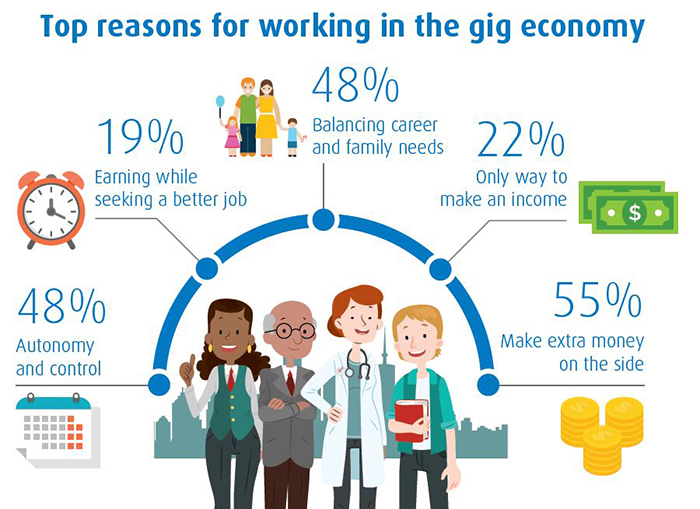
Work is more than just about money, it is about social status, individual fulfilment and personal satisfaction. A study by the Harvard Business Review reveals that gig workers experienced personal, social, and economic anxieties in the absence of a traditional employer. On the positive side, the independence of a gig worker is a choice they love in the long run. They lead much richer lives than their corporate counterparts. Working long hours, modest financial returns, no social benefits and challenging work conditions are the downside. In the brave new world of the gig economy there is no mentor, no HR or kind colleagues to help climb the ladder of success. In today’s reality nobody will get a chance to say “I never saw it coming” when they are eased out of their jobs. As people get swept under the tide of change, it is imperative that we understand and embrace the gig economy voluntarily. To quote Paul Oyer of Stanford Business School: “Giggers collect 15% higher amounts than people in traditional jobs doing the same work.” It is therefore a myth that working free lance is not economically viable. It is time to disrupt our thinking and look for new avenues to bring out the business entrepreneur in each one of us. As we enter unchartered waters, it may benefit to follow the advice of French novelist Gustav Flaubert: “Be regular and orderly in your life…so that you may be aggressive and original in your work.” The old order changes, yielding place to the new but we can rest assured that in the post-pandemic world, the gig economy is here to stay!

Tuesday, 20 October 2020

Classic Guns of the Raj by Ajay Singha - Raconteur Indica

After he was appointed the heir presumptive to the British throne, the grandson of Queen Victoria, frequently visited Her Majesty’s domains on hunting and shooting excursions. He infused a fair amount of style, fashion, etiquette and fervour in these activities. The related brouhaha reached its’ zenith when he was declared King of England in 1910 and was fondly known as George Pancham (George V) to the people of the Indian sub-continent. Maharajas, Nawabs and the titled gentry of the Raj in India left no stone unturned to emulate his style and related paraphernalia. Shooting sports emerged as the favourite hobby of the high and mighty in the days of the Raj as it bore the stamp of imperial approval. In fact it constituted the very epitome of what the empire stood for and keenly perpetuated amongst the ruling classes of India.

For the ruling elite of the Indian sub-continent, importing high quality bespoke firearms from Great Britain gained popularity by 1900s. Never to miss an opportunity, British gunsmiths created fine pieces of sporting guns for sale at exorbitant prices to rich individuals, maharajas and the nobility. Custom made, individually crafted and highly decorated guns with personal names engraved were sought after. The ruling class during the days of the Raj were an adventurous lot, spending considerable time outdoors. They had to govern and rule over vast tracts of land and in the process had a good time, albeit at the cost of others. Shooting “game” had become ideally suited for people whose persona comprised of some western education, political and social influence and a good amount of money to spare.  To go on “Shikar” and own high quality, made to order firearms became inextricably interwoven with the lifestyle of the power elite. Much like possessing a Rolls Royce, owning bespoke firearms and related accoutrements was now a distinguishing feature between the privileged, who hunted for pleasure and those who poached wild life for sustenance.

British manufacturers of bespoke firearms who supplied sporting guns for India’s elite in the late 19th and early 20th centuries were James Purdy & Sons, Holland & Holland, Westley Richards, EJ Churchill, Boss & Co, John Rigby and WJ Jeffery. For big game hunting in India, British gun makers also developed exclusive calibres for India. Starting with black powder 500/450 Express in the initial years, followed by 375H&H, 416 Rigby, 275Jefferys, 30Super and the famous 577 Rewa named after a then incumbent Princely State.  For small game and bird shooting which was plentiful across India, the popular choice was 12, 16 or 20 bore shotguns. All game birds were sought after but only on the wing. Shooting a sitting bird was now considered unsporting, frowned upon and seriously discouraged. 

Sand grouse, teal, duck, partridge, quail were found in large numbers then and presented challenging targets on the wing. Thus arose the need to order a pair of guns so that precious time was not lost in reloading and gun bearers were trained to quickly hand over loaded guns to ensure uninterrupted shooting. Records of Imperial Sand Grouse shoots at Gajner in Bikaner and duck shooting in Bharatpur bear testimony to immensely large bags, as several VIP guns blazed in organised shoots. This was followed by elaborate al fresco lunches and photo sessions featuring the high and mighty of the Indian sub-continent. Very often the days’ bag comprised various species of game birds and hence the term “Mixed bag” became popular in the English language. In addition to pairs, those who could afford, used triplets of the same gun make. The Viceroy of India in 1880, Lord Ripon was recognised as the finest shot in the British Empire and the last word in shooting on the wing. He had an enviable record of shooting 556,500 game birds in his lifetime.

In big game shooting, to shoot a running animal during the course of a beat was considered fine sport, much like shooting only flying birds in small game. Beats or “haakas” were organised for this type of serious Shikar in Princely States of the Raj. A large group of villagers were ordered to walk through the forest beating drums and trumpets in an organised manner to move out the big game towards a pre-determined forest clearing. As the animals crossed a forest clearing bereft of trees and undergrowth at break neck speed they provided a sporting chance of a few seconds to big game enthusiasts. The shooter had to be a good shot with a rifle and very quick on the uptake or forego the chance till the next beat commenced.  This unique feature gave rise to the manufacture of high quality double rifles which looked like shotguns but were in fact breech loading double barrelled rifles. Later bolt action rifles were added to the collections of discerning big game shooters. Tiger, Leopard, Bear, Stag, Wild boar and various antelopes were felled by these made to order rifles. 


Each of these unique made to order guns of the Raj had a serial number and to this date the original owners of these priceless pieces can be traced. With heavy engravings, carvings, year of manufacture, name and title of the owner was prominently mentioned on the gun. Very often the metal engraver, himself an artist of repute, left his initials on the insides of the engraved side plates.
A large part of the global business of these British gunsmiths was for the Indian ruling elite. Made from the finest gun metals available at that point in time, the guns were test fired and proofed by specialists who stamped each weapon individually. Safety and quality was paramount and therefore assured for the most discerning clientele. In the Princely States of Rajputana it appears that Bikaner had a liking for Holland & Holland (H&H) and was responsible for developing a hybrid called the “Paradox”. This was a 12 bore shotgun but could fire slugs for big game and bird shot when required. The last six inches on the fore end of the barrel had rifled grooves much like in a conventional rifle. The H&H Paradox were used for big game shooting by the Bikaner Royals and became a favourite topic of discussion at post Shikar celebrations across the Raj. A Paradox now owned by a friend, was kindly allowed to be used by me to get a taste from a bygone era when sporting guns, like clothes, were tailor made to fit individuals. The Maharaja of Alwar focussed mainly on Rifles from Westley Richards as big game was plenty in the State. Bharatpur was another aficionado for shotguns and the Maharaja had organised a duck shoot as late as 1961 for Prince Philip where a 20 bore pair made by James Purdy was used by my father who also attended the shoot. Much later, accompanying my father, we visited the Maharaja. He was kind enough to show us the same pair of 20 bore shot guns and allowed me to fire a few shots. The Maharaja of Kishangarh in addition to importing, also procured some of these fine guns from Bikaner State. There was hardly a Princely State with a gun salute or a famous person featuring in the Who’s Who of India 1942 (Imperial Publishing) who did not possess a bespoke firearm. The Maharaja of Jodhpur had a huge collection across all makes, brands and calibres as they were fond of both small and big game shooting. 

Some of the owners developed a strong emotional bonding with a favourite weapon, an emotion which can be appreciated by present day gun aficionados. In 1948 when Pakistani tribesmen closed in on Srinagar, the Maharaja of Kashmir was advised to vacate his palace without much notice. Understandably only precious items and jewellery would be carried in such a situation but the Maharaja added his favourite pair of Purdy shotguns before commencing his journey.

People of our generation had the chance to experience the tail end of this unique phenomenon of the Raj which dominated the lives of the social and economic elite. The larger than life stories around hunting excursions, the great outdoors and the fine quality guns used, find some audience even today. I recall one such story recounted by an erstwhile noble. Villagers requested him to eliminate a leopard which frequently attacked their livestock. The young Prince ventured out to shoot the Leopard and selected his grandfather’s hammered 500 H&H for the task. He had never used it but had heard many a Shikar stories featuring this weapon. In the late evening when they were sitting near a goat-kill and were about to confront their quarry he tried loading the rifle only to realise that the cartridges he had brought along were marginally sleeker than the Chamber of the Rifle in hand. It struck him then that the cartridges belonged to his 375 H&H double rifle. Realising they were now unarmed and a dangerous quarry was lurking, he looked at his tribal hunting assistant who was armed with a catapult. The fellow was a great shot with his catapult and wasted no time in loading a round lead ball in his catapult. In a few moments the leopard approached, the assistant took careful aim and pulling the catapult to its’ full length, released the projectile to hit the leopard on his forehead. The leopard was stunned and was speared before it could regain consciousness. Later when they examined the skull of the leopard it was found that the metal projectile had cracked the skull and was lodged firmly in the brain. For several years the leopard skin and the projectile were proudly displayed in the palace and formed the topic of excited conversation over drinks. What the mighty Holland & Holland could not achieve was performed by a lowly catapult. I heard this story around 1970 on one such evening when accompanying my father for dinner to the Prince’s palace.

From the beginning of the 20th century till Indian independence this great interest in made to order, high quality rifles and shotguns flourished. As the sun finally set on the Raj, the proverbial cat had vanished but the smile remained, at least for a while. Classic hobbies, interests and past times including sporting guns continued among the social elite for some more decades. The death knell for these and related interest was finally sounded by the unceremonious removal of the privy purses of the Indian Princes in 1971. The famed British manufacturers of these exclusive weapons started visiting India to buy back most of these exclusive guns. They were purchased for meagre amounts of money, reconditioned in England and marketed, like a piece of Indian history, to rich buyers in the Middle East, USA and Europe.  Subsequent enactments of laws and rules by the Indian government ensured that this last vestige of the Raj was completely obliterated for all times to come and another fine and glorious Indian heritage was consigned to the dustbin of history.

HH Dholpur duck shooting with a pair of Westley Richards


Maharani Gayatri Devi  possibly with a 30SuperH&H Double Rifle (accompanied by HH Jaipur)


Maharani Tara Devi of Kashmir used a Classic Double Rifle to bag this magnificent stag


HH Bikaner used a Classic Double Rifle or a Paradox H&H on this Tiger

 
Bespoke Shotgun of HH Maharaj Rana of Dholpur. Note crocodile gun case


Saturday, 25 April 2020

A Post-Covid World


A Post-Covid World
by Ajay Singha-Raconteur Indica.

As we inch closer to the imminent removal of lock down restrictions, the question on everybody’s mind is: Will it be business as usual?

It is widely believed that “Clues to the future lie in the past”. Social scientists and historians will testify that human nature has not changed much over the past few millennia. Great wars and plagues are known to have reignited economic forces and reinforced the individual’s will to impose human dominance and control over nature. Pacifists and liberals may predict the opposite but the unchanged human nature, with its insatiable and unbridled desires continues to stride ahead. A period of intense economic activity and severe social struggle will ensure that the future will be a difficult, challenging yet most exciting time to live and work in. This paradoxical environment will witness young people across socio-economic segments working and living primarily for the present. We have already entered a period of uncertain geo-political and unpredictable economic realities.

These conditions will most certainly lead to a short term approach towards business decision making and personal planning. The gig economy will grow in the foreseeable future, which implies that in the business world co-operation with new partners and strategic tie-ups even with competitors will become the new normal. Outsourcing contracts, task jobs and freelance work is what the Indian economy thrives on and will see exponential growth. Experience, both from overseas and India leads us to believe that artificial intelligence, big data, and internet of things will make business more resilient to future uncertainties or any “black swan” eventualities.

At an individual level this change will mean that each person must become a life-long learner, who appreciates and understands the key drivers of the industrial revolution 4.0. This would further translate into work from home: companies will hire and engage people who can keep the digital business running, make it more efficient and less prone to breakdowns. Employees will therefore need re-skilling, training with new modules and SOPs that will make working from home more effective. The changed environment will demand new systems and approach creating a vacuum of immense opportunities for new business across borders. Nature abhors vacuum, India and Indians will greatly benefit and prosper if this void is filled in, adopting a positive and dynamic approach.

During the quarantine period there was ample time to introspect and sort out existential issues facing one’s reality. This exercise will lead to reassessment of individual world views, altered lifestyles, new approach to socialising and resultant attitudinal changes amongst people. Indian society will now encounter a fresh set of challenges which emanate from India’s diverse and multi-polar construct. A newfound tolerance for restrictions has become acceptable amongst the relatively evolved and educated segment of society. This phenomenon has not permeated to the less privileged and functionally literate masses. Friction between the compliant and non-compliant segments of society is imminent and likely to spark social, economic and subsequently political disturbances across the continents like the recent protests in USA.  This adds to the prevailing levels of uncertainty, fuels the high risk economic environment and results in short term perspectives for all decision making.

We must never forget that history is witness to periods of stability followed by chaos and mayhem sometimes for such extended periods that they were termed, “the dark ages”. Across the world there is a move away from globalisation and towards nationalism. The widening gap between the rich and the poor, religious extremism, volatile markets, shifting tides of migrants make the world an unstable platform. The world requires social and economic stability at a collective and individual level, poignantly phrased by Aldous Huxley in the Brave New World: “No Social Stability without Individual Stability”. Political leadership will play a key role in ushering this environment. We should therefore expect a period of immense social change, relative political stability and sustainable economic growth.

On the eve of 2020 as the world was bringing in the new-year, a deadly virus had been discovered and within 100 days spread across 184 countries. Human kind was locked in a battle against an unseen enemy who refused to distinguish between nations, religions and social classes. Olympics have been postponed, schools closed and a lasting scar etched on the human psyche. In the past the world experienced several diseases for which no medical cures exist till date. Yet society lives with them by adjusting lifestyles and incorporating effective preventive care. Indians young and old must learn to celebrate the human spirit and trust mankind’s ability to repeatedly surmount impossible odds stacked against the historically suffering humanity.